Never Forgotten 2024: War & Peace

Welcome back to the Podium!

When last we left off, I had just finished writing my composition In Memoriam (also known in Korean as 추도), commissioned by the Grand Philharmonic Orchestra in Seoul, South Korea, for premiere at the 2024 edition of the Never Forgotten concert series, subtitled War & Peace.

While I thoroughly enjoyed my first trip to South Korea earlier in the year (and, of course, could not wait to return), I had not expected or anticipated that my next visit would be quite so soon. As this concert was a non-profit event (and airfare from Toronto to Seoul is decidedly not cheap!), I was not even seriously considering attending my own premiere. However, when I found out that the three other commissioned composers would be in attendance, two of whom would be flying in from Los Angeles, I decided that this was an opportunity I could not pass up. After all, I couldn’t be the only composer not there, could I?

I planned to only be in the country for about five days, arriving the night before the first rehearsal and departing the night after the concert, with most of my schedule dedicated to the performance and related activities. I wouldn’t have too much free time for sightseeing — and I am thoroughly grateful to have made the longer trip earlier in the year for pretty much just that — but I knew that I would have a good time all the same.

War & Peace

Four days before my departure, I woke up to a barrage of text messages from worried friends over the declaration of martial law by President Yoon Suk Yeol. While I was grateful for their concern, I was undeterred; until and unless official travel warnings or advisories were issued, nothing would stop me from being on that plane. In the unlikely event of an emergency while I was in Seoul, I knew how to reach the Canadian embassy (which, as an aside, I had been trying to contact to inform them about our concert and my involvement in it, though to no avail — and since 2024-2025 had been declared the Year of Cultural Exchanges between Canada and South Korea, I thought for certain that they would have been interested in hearing about this!). From the news reports that emerged in those early hours, this event had echoes of the December 12 coup that was still in recent generational memory (depicted in the movie 12.12: The Day (서울의 봄, Seoul-ui bom, lit. Soul’s Spring), which I watched on the plane) — though in this case, democracy prevailed. All things being equal, it seemed like a strangely apt backdrop to our concert, which, by sheer coincidence, happened to be taking place on the 45th anniversary of the coup.

I had gone from a sense of ambivalence over even attending the concert to feeling like too many things had to have aligned over the span of years in order for this opportunity to be possible just to let some pesky martial law get in my way (which, in the end, was repealed just as quickly). Cheekily, I thought that what the parties involved really needed was to just come down to a concert and listen to some good music — perhaps one themed on aspects of war and peace. 😉

Over the next few days, my pre-departure checklist included acquiring a new suitcase, retrieving my new concert suit from the tailor, picking up my personal-sized copy of the score to my piece from the printer, and hoping that political tensions would cool — or, at least, be kept to a suitable simmer. Truthfully, as I was staying nowhere near the major political demonstration sites, life in Seoul was essentially business as usual.

As is my usual practice, I had taken the responsibility of orchestrating my own composition — that is, turning the music from its MIDI demo format into a proper conductor’s score — and copying my own parts for the musicians, so I expected there to be no surprises in front of me (in fact, I may have stared at it all far too much over the course of the previous month). What I hadn’t expected, however, was how deeply moved I would feel the moment I held my printed, bound score in my hands. With my departure the next day, and the premiere in a week, the gravity of the previous few months all finally hit me. This was real.

Back to Seoul!

I took my first morning back in Seoul to explore the local neighbourhood of Yeoksam-dong in Gangnam, finding my way to a nearby eatery that I had previously enjoyed in Busan for a cheap and cheerful breakfast, before preparing for the day ahead. I joined our intrepid concert organizer (and my trusty hubae), Michael Choi, for lunch nearby, finding him with a batch of freshly-printed full-size scores under his arm.

(Looks like I didn’t need to have made my own copy after all. Oh, well.)

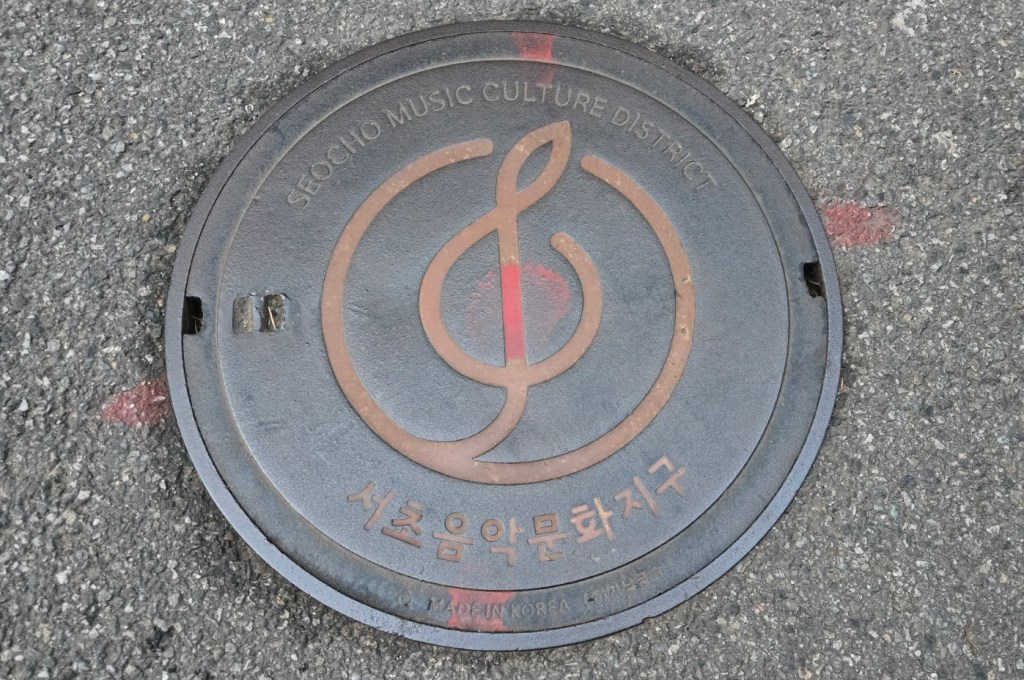
If everything felt real a couple of days prior at the printer’s, it felt even more so — literally writ large — with the full-sized copy of the score in front of me and our first downbeat 90 minutes away. The rehearsal hall was a tight room, barely large enough for the 57-piece orchestra, in the basement of a building dedicated to what seemed like all things music, with the five floors above filled with rehearsal studios and instrument stores. This was one of many such buildings in the Seocho-dong area of Gangnam, a neighbourhood renowned for being a hotbed of musical activity: concert halls, music shops, rehearsal facilities, and restaurants with music-inspired names lined the streets, which themselves were dotted with treble clefs.
The energy in the room was palpable as the orchestra settled in for our first rehearsal. I did my best to politely greet as many of the musicians as possible in my rudimentary Korean, and expressed to the conductor, Maestro Hoon Suh (서훈), that it was an honour and a pleasure to meet him. In the span of our three-hour rehearsal, we ran through the full concert program, which featured the four original commissions for this year’s concert (Names of the Soul (영혼의 이름) by Hyunmin “Gangyu” Kang from South Korea, Echoes of Haeinsa (해인사의 메아리) by Maclaine Diemer from the United States, In Memoriam (추도) by me, and All ANZACs Remembered (ANZAC을 기억하다) by Catherine Joy from Australia), two pieces reprised from the inaugural Never Forgotten concert (Bloom (꽃으로) by Jinho Choi, featuring pop vocalist Dongyeon Ha, and Never Forget (불망) by Michael Choi, featuring pansori vocalist Suwon Kim, all from South Korea), four tunes from the discography of Jinsub Byun, a famous pop singer from the late ’80s, arranged for orchestra by Kayoun Yoo, Wani Han, Jiyeon Julie Lee, and Sojin Ryu, one film cue by South Korean composer Jisoo Lee, and two themes from films scored by Dongjune Lee.

For a first rehearsal, it went fairly well, and I knew that things would only improve from there. All the same, I wished that I could have been able to convey my feedback to them directly in the moment (note to self: keep working on my Korean!). As we had to cover the entirety of the program’s repertoire in the limited rehearsal time, Michael advised me to send him my notes by e-mail afterward, which he would translate and relay to the conductor on my behalf in time for our next rehearsal.

It was satisfying to hear the musicians begin to bring our pieces to life. It was exciting to be there, and I’m not sure that I had smiled quite so hard in more than ten years — not since my recording trip to London in 2014! I was in awe of the other pieces on the program, and was thrilled to meet some of my fellow composers and arrangers. It was even entertaining to watch Michael grab the cymbals and make his debut with the Grand Philharmonic Orchestra during the rehearsal of Jinho’s piece, and, in the absence of Jinsub Byun, to hear Dongyeon and Michael turn our rehearsal into an impromptu karaoke session as the orchestra read through the arrangements of the famous singer’s tunes.

I looked forward to welcoming Maclaine and Catherine (the latter I had not seen in ten years!), who were soon to be winging their way across the Pacific from Los Angeles. I was also champing at the bit to meet Dongjune Lee, whose stature in the South Korean film industry rivals that of Alan Silvestri in North America — and whose work I was familiar with, from way back in November of 2004 when I saw Taegukgi: The Brotherhood of War during its limited theatrical run in Toronto! While he indeed attended a portion of the rehearsal (and, I’m told, the pace of the proceedings were understandably adjusted to fit his schedule), with the way that he breezed in and out, my gushing over being a complete dork having the opportunity to be properly introduced to him would have to wait.

As the next day was an off day on our schedule, I had planned to meet another musical colleague who happened to be in Gangnam that afternoon, followed by a shopping trip to Myeongdong in downtown Seoul, up on the northern side of the Han River. I coordinated with Michael to return to the hotel in the evening to greet the newly-arrived Maclaine and Catherine, and join them all for a composers’ dinner.

The day after promised to be a long, full day, starting with a visit to the National Gugak Center (국립국악원), the institution dedicated to teaching and preserving traditional Korean music (gugak). We were given a guided tour of some of the facilities by one of the instructors (also a professional contact of Michael and Maclaine), though as the Center was in the midst of its audition season, some of the spaces were off-limits and the site was fairly quiet. However, most of the Gugak Museum was open, and, owing to my long-standing interest in that kind of music (in tandem with my interest in and experience with various musical traditions of Japan and China), getting to see specimens of traditional Korean instruments and notation up close left me feeling like the proverbial kid in a candy store. I only wish that we could have had the opportunity to observe an ensemble rehearsal or actually try some of the instruments. Maybe next time. 😉

After being treated to a sumptuous barbecue lunch, we returned to the rehearsal hall for the second of our three rehearsals for Never Forgotten: War & Peace — this time, with Maclaine and Catherine in attendance! For my part, it was encouraging to hear that my feedback had been heeded and that things seemed to be progressing well toward performance shape. The second half of the rehearsal, following the concert order, was dedicated to the film music and pop music on the program, but again, missing the vocal stylings of Jinsub Byun. After we each had an opportunity to convey our further feedback to the conductor (with one of the arrangers serving as interpreter), we were whisked away to our evening program.

A Touch of Hollywood in Korea

Michael had arranged a special event, Hollywood in Korea 2024: Winter Composer Forum, featuring the three North America-based composers from the Never Forgotten concert (Maclaine, Catherine, and yours truly) as guest speakers, joined by a South Korean indie film composer, Yonrimog. We were each expected to prepare a short speech or presentation discussing our career path, and play a featured excerpt or piece of music, before opening up the floor to an informal networking and question-and-answer session with the attendees, most of whom were young Korean composers, musicians, and songwriters.

Knowing that I would be in front of a largely-Korean audience, I chose to connect with them about an early part of my career that I admittedly don’t talk too much about anymore, but was essential to my development as a composer all the same. In my formative years of writing music, I held what was tantamount to a virtual career in the North American version of a certain South Korean online roleplaying game (the Korean title of which, I noted, was recognized by many in the audience). I hesitate to call it an MMORPG, as it never captured the same degree of player base or market share in North America as its contemporaries (like Ultima Online or EverQuest), but what it lacked in that, it more than made up for in user-generated content. The tight-knit community was thriving with fan art, fan fiction, original poetry… and then there was me, who wrote what was essentially fan music. Appointed by the in-game royalty as their court composer, I would be commissioned by other players — my noble patrons, so please you — to compose real, original music for various in-game functions — anthems, ceremonies, festivals, events, and more — and paid in-game currency. Although my in-game career was virtual, it gave me a healthy amount of very real practice writing music to order and maintaining relationships with clients, as well as demonstrating quite the entrepreneurial spirit, if I do say so myself — all of which are elements that still serve me well to this day in my actual, current career as a composer. Given that chapter of my personal history, demonstrating my lengthy connection to Korean media, culture, and history to the crowd, I indicated that it was so meaningful for me to be in Seoul for the world premiere of my latest composition. Somewhere, a younger version of myself is smiling.

(Two days later, Michael told me that he used to play the original Korean version of that same online RPG when he was younger. I swear, there are no coincidences.)

For my signature piece, of course, we played the video of me conducting Flight. In my previous post, I mentioned that Michael, on his way to Berklee in Valencia, reached out to me after finding my work online. What he hadn’t told me until that moment at the composer forum, in front of the entire audience, was that it was the recording of my piece that inspired him to change his entire career trajectory and pursue film scoring at Berklee in Valencia. For my music to have actually had that much of an effect on someone… I was truly touched beyond words. 🥹

(I want to give a special acknowledgement to our interpreter, Vyvyan Kim, for being such a good sport about the curveballs I threw during my presentation!)

I hadn’t truly recognized our fourth panelist, Yonrimog, by name, until she started listing her filmography… and then I realized that not only had I heard of her, but that I had, in as many months, seen two features that she had scored (including her latest film, The Land of the Morning Calm (아침 바다 갈매기는, lit. The Morning Seagull) at the 2024 Toronto Reel Asian International Film Festival)! I think she was as surprised to find someone from the other side of the world who knew who she was as I was to be seated next to an indie Korean composer whose work I knew. If this isn’t yet another demonstration of how tiny the world is (especially when it comes to music and the global entertainment business), I don’t know what is.

Similarly, I honestly wasn’t expecting anyone at the event to have known who I was, either, but during the networking portion of the evening, an American songwriter approached me who recognized Flight from apparently having seen the video sometime in the past decade!
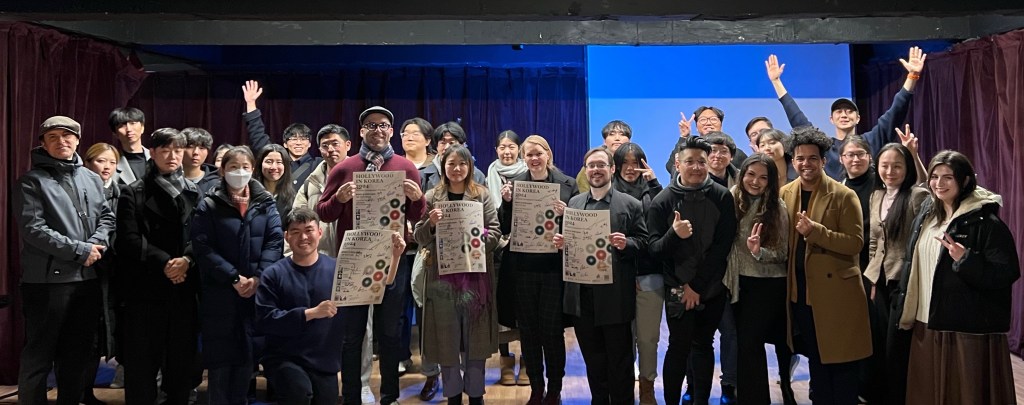
I am always grateful for the opportunity to share my experience with the next generation of musicians and composers — particularly such an energetic and attentive crowd as this! — and it was truly wonderful to get to do so alongside friends and colleagues old and new.

Concert Day

December 12th had come at last. Around midday, we made our way across the river to Yongsan. Practically next door to Itaewon, Yongsan is home to the National Museum of Korea, the War Memorial, and our concert venue, the Yongsan Art Hall, a concert hall built into a sizeable governmental complex that serves as the administrative building for the district and doubles as a medical centre.

…as you do.

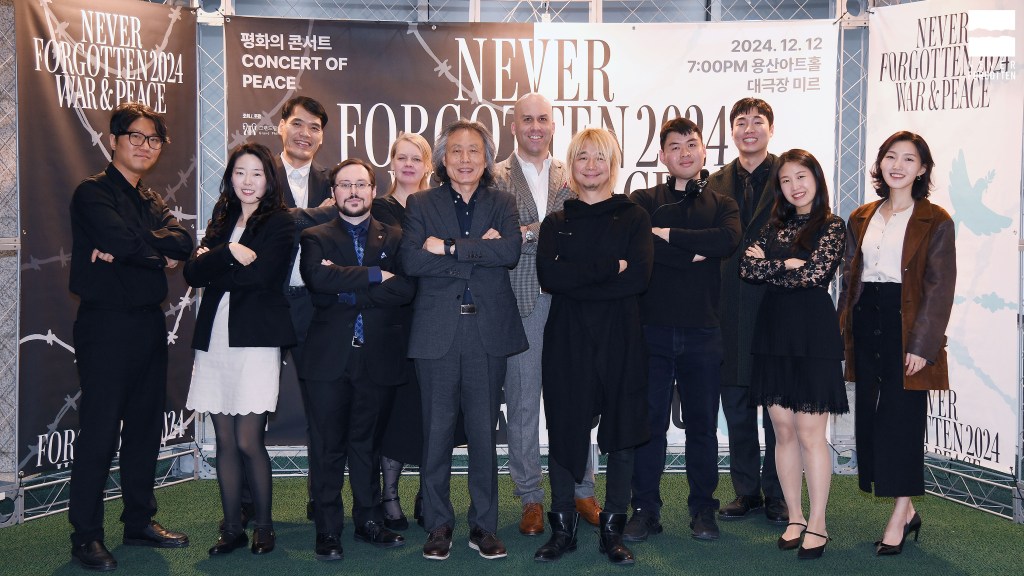
While the hall was empty, save for Michael and the technical team setting up for the day’s proceedings, the room was filled with anticipation. Soon, the orchestra would arrive, and we would run through the program one last time as a dress rehearsal, followed by our pre-show photocall, with barely a break for dinner in between!

It was a welcome change to have the ensemble in the hall — and, for that matter, getting to hear the orchestra from the audience’s perspective, rather than being crammed into the back of that small rehearsal room, behind the musicians! We sank into the plush seats of the auditorium and let the sound wash over us. It was magnificent.

I marvelled at the work that the orchestra had put into our pieces in such a short amount of time, particularly admiring those of my fellow composers. I was still mildly apprehensive about how In Memoriam fared compositionally in comparison to the other pieces on the program; perhaps it was just pre-show jitters.

In the second half of our rehearsal, we were graced by the presence of Jinsub Byun, live and in person! His team of handlers prohibited me from even taking a still photo of him during the dress rehearsal, so you’ll just have to trust me. Admittedly, I was unfamiliar with the oeuvre of this particular singer — my K-pop knowledge really only goes back to around the early aughts, from my time as a BoA fan — and, though I understood perhaps one word in five, the vibe of the four songs of his on the program (Wish List (희망사항), The Only Thing to Give You is Love (내게 줄 수 있는 건 오직 사랑 뿐), Like the Birds (새들처럼), and, in duet with Dongyeon Ha, We Need Our Love (우리의 사랑이 필요한거죠)) seemed to be decidedly lighter fare than the rest of our more emotional, evocative works.

However, it was explained to me that Byun and others of his vintage represented the cultural renaissance that South Korea experienced as it emerged from the dictatorship in 1988, and many Koreans (particularly of a certain generation) would therefore have a positive association with those songs. I certainly couldn’t argue with the concept (or the ticket sales), and hey, when’s the next time I’ll be able to say that I opened for and shared the stage with a bona fide K-pop star? 😜

Shortly before the concert, not knowing when I would have another opportunity to do so, I asked one of our arrangers to help facilitate a moment of face time with Dongjune Lee. Not only did I want to formally meet him and tell him that I had known of him and his work for 20 years, but more importantly, I wanted to do the very Canadian thing of giving him a tiny bottle of maple syrup as a souvenir. During the afterparty, of course, I couldn’t possibly leave without asking him for a selfie.
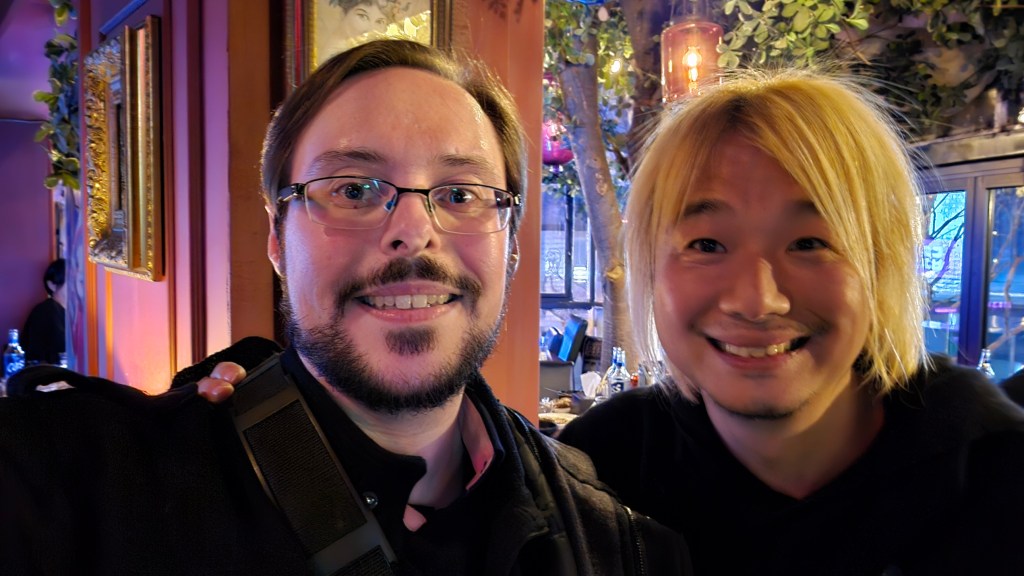
The concert itself passed by in a flash. Our music filled the hall to a most receptive audience (at least some of whom, judging by their reaction, may have been there mostly to see Jinsub Byun). Reporter Soongon Lee of Beyond Post commented on our “unique orchestral music that combined classical and cinematic sensibilities.” True to the mandate of the concert, veterans from the Vietnam War and the Korean War were honoured during the performance through a series of video tributes, as well as one poignant moment where a group of them in attendance were applauded.

Now, dear readers, it is my honour to share the video of the world premiere of 추도/In Memoriam with you here:

The next day, still buzzing from the excitement of the night before, I packed my bags and joined my colleagues for lunch and shopping in Gangnam one last time before I made my way back to the airport for the long flight home… while Michael started to plan for Never Forgotten 2025.

I want to express my congratulations to fellow composers Hyunmin “Gangyu” Kang, Maclaine Diemer, and Catherine Joy on the premiere of your works, to Jinho Choi, Jisoo Lee, Jinsub Byun, and Dongjune Lee on your music rounding out the performance, to Wani Han, Jiyeon Julie Lee, Sojin Ryu, and Kayoun Yoo on your masterful arrangements, to Maestro Hoon Suh on your sensitive and artful direction of the brilliant musicians of the Grand Philharmonic Orchestra, and, of course, my gratitude to Michael Choi for organizing this concert and granting me the opportunity to contribute to it. It was an absolute honour to share the stage with all of you.
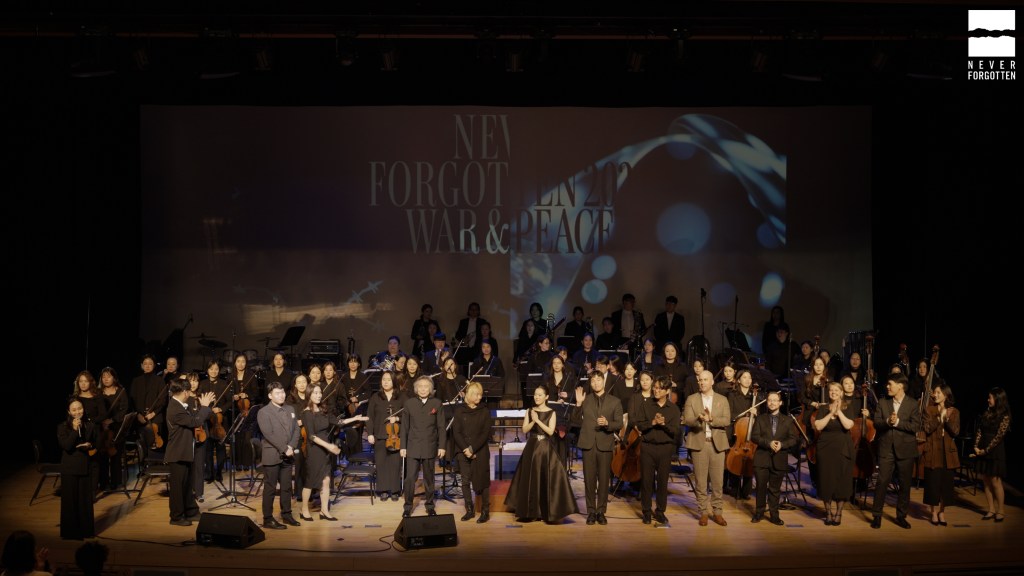

추도/IN MEMORIAM premiered at Never Forgotten 2024: War & Peace at Yongsan Art Hall in Seoul, South Korea, on December 12, 2024, performed by the Grand Philharmonic Orchestra, Maestro Hoon Suh directing. For further performance inquiries, please use the contact form on this website.

Inside the Federmusik: In Memoriam

The view from the podium — in Seoul!

Despite the title of this entry, and contrary to the lack of activity on this blog (hello, last post being the better part of two years ago), I am indeed still alive.

Over the past two years, I have been happily pursuing many and varied musical activities — scoring for films and other media, writing arrangements for concerts and events, orchestrating and doing sheet music preparation for various projects (including the video game Avatar: Frontiers of Pandora), conducting recording sessions, furthering my study of three sizes of viola da gamba (both at home and internationally!) — and have overall been trying to build back my practice as a musical multi-hyphenate in a way that is healthy and sustainable (almost in defiance of industry norms! 😉). I just haven’t had too much to say about them in a way that would be particularly interesting as a blog. Do people still blog anymore?

I am, however, eager to share my latest news with you.

Today, I celebrate the release of my latest composition, In Memoriam (also known by its Korean title, 추도, pronounced chudo), out now on Spotify, Apple Music, and YouTube.

Wait, Korean?

I may be getting ahead of myself. 😅

In May and June of 2024, I took the opportunity to visit South Korea and Japan as a special 40th birthday present to myself. It had been several years since I had travelled anywhere by air, my last time being a quick trip to New York City for the American premiere of The Suitcase in 2018, immediately before scoring Haru’s New Year. It had been even longer since I had flown overseas — a trip to Poland to assist my mentor, Paul Hoffert, with a concert and a documentary in 2016 — and 16 years since I last crossed the Pacific. I had long desired a return to Japan ever since I returned home from my last visit in 2008, and Korea had always been on my travel wish-list — and I figured that since my music had already been there (courtesy of Haru’s New Year screening in festivals in Seoul and Busan), it was long past time for me to follow.

Hanging out with my mentee, composer Michael Choi, in Gyeongju.

While in South Korea last summer, I finally had the chance to meet one of my mentees (or 후배, hubae), Michael Choi. Back in 2016, having found my work online, Michael contacted me shortly after his acceptance to Berklee in Valencia, where he was about to embark on the Master of Music in Scoring for Film, Television, and Video Games program. He was eager to hear about my experience in the program, and I was happy to oblige. We kept in touch during and after his year in the program, and I am proud to see how, in the intervening years, he has developed into a very fine screen composer in his own right.

In addition to working as a composer, Michael established an orchestral concert series in 2023 called Never Forgotten, held in commemoration of the 70th anniversary of the Korean War armistice. Under the direction of Maestro Hoon Suh, the Grand Philharmonic Orchestra in Seoul performed a program of new works mixed with film music, all themed on aspects of war and peace. Michael shared the recording from the concert with me when I visited him at his professional base in Busan, and he mused about potential future iterations of this concert featuring more international composers in its lineup.

A few weeks later, after I had returned home to Toronto, I received a message from him, on behalf of the Grand Philharmonic Orchestra, commissioning me to compose a new work to be premiered at the second edition of this concert series, Never Forgotten 2024: War & Peace. He explained that the aim of this year’s concert would be to preserve the memory of the Korean War and the Vietnam War, to honour our veterans and those who made the ultimate sacrifice, and, of course, to pray for peace. I was to be one of four international composers invited to contribute a new work to this performance, each of us representing one of the many countries that fought for the United Nations coalition forces during the Korean War; I was, and remain, deeply honoured to have been asked to represent Canada at this concert.

Similar to the inaugural concert, each of us participating in Never Forgotten 2024 would be given a different topic or aspect to serve as our inspiration for our compositions. My commission, formalized several weeks later, was to write a standalone symphonic concert piece, running between 3-7 minutes in duration, reflecting on the sorrow of war, the tears of the innocent, and mourning the lost.

That was it. No picture to enhance. No director’s feedback. No narrative aside from anything I might come up with in my own imagination. No click. No synths or prerecords.

Just me, up to 7 minutes with an orchestra, a poignant (if suitably broad) topic for a brief, and about two months until my first draft was due.

No pressure.

In today’s episode, we will take you inside the Federmusik to examine the compositional process of 추도/In Memoriam, and then in my next entry, I’ll tell you more about my time in Seoul for the rehearsals and performance of the Never Forgotten 2024: War & Peace concert. Happy New Year — or, more aptly, 새해 복 많이 받으세요 — and welcome back to the Podium!


An Immense Responsibility

Immediately, I felt the weight of the responsibility of this commission: a new orchestral work, to be performed by a 57-piece orchestra, representing my home country on an international stage, honouring the memory of those lost in war. I read about the Korean War and Canada’s role in the UN coalition. I thought of my family members who both survived and perished in the Holocaust. I remembered my trip to Mauthausen in Austria, walking in the footsteps of ancestors I never knew. My mind went to all of the current global conflicts and suffering. My heart ached.

Further, while orchestrating and arranging other people’s music for ensembles of all sizes has become a regular part of my work, and for as much as I pride myself in my orchestral skills — heck, the first impression that I make on this very website is me directing a full orchestra! — it had actually been a few years since I had last composed anything original for orchestra, and even longer since I had done so for an actual live one! I couldn’t even remember the last time I wrote an honest-to-goodness concert piece that wasn’t an adaptation of something I had previously written for a film or game!

On top of feeling more than just a touch out of practice, I would be lying if I said that the spectre of iconic orchestral masterworks that are immediately associated with concepts surrounding the sorrow of war (like Samuel Barber’s Adagio for Strings or John Williams’ theme from Schindler’s List) didn’t loom large in my mind. At all.

This was daunting.

It took a few weeks of reflection to begin getting my ideas in order, sketching out melodic ideas in my notebook (as I usually do), and a few more before I was ready to translate my scribbles into a more useful form and start composing in earnest. I decided to approach this piece as I do anything with this much responsibility: with simple sincerity.

The overall tenor of this piece would be heartfelt and mournful, yet contemplative and understated. I had to take care to never devolve into sentimentality or melodrama, and, for once, keep the orchestral bombast to a tasteful minimum. It would be long and lyrical, owing to my penchant for melody and my chosen approach to the subject matter (and, as an added bonus, knowing that having a strong melody would also help the piece connect well with my Korean audience). Most of all, it needed to come, as composer and Holocaust survivor Leo Spellman (of blessed memory) used to tell me, from the heart.

I drew inspiration from the end of the Book of Lamentations to craft a prayerful melody, and ended up with a meditation on the nature of memory, grief, and guilt born of the sorrow of war. It was my hope that this composition, with its solemn message of peace and remembrance, could help all those at the Never Forgotten 2024 concert join together in a moment of collective reflection.

Theme Breakdown

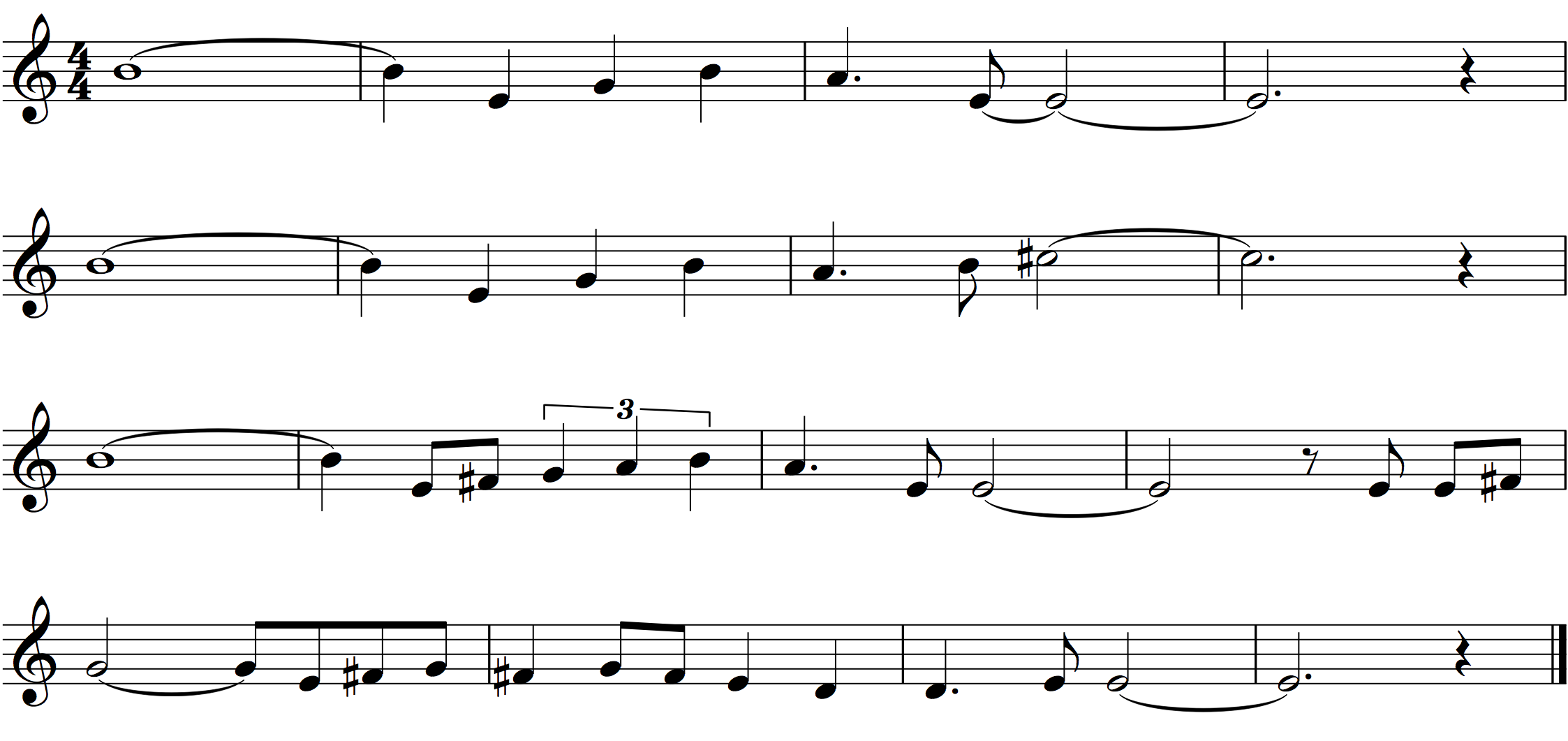
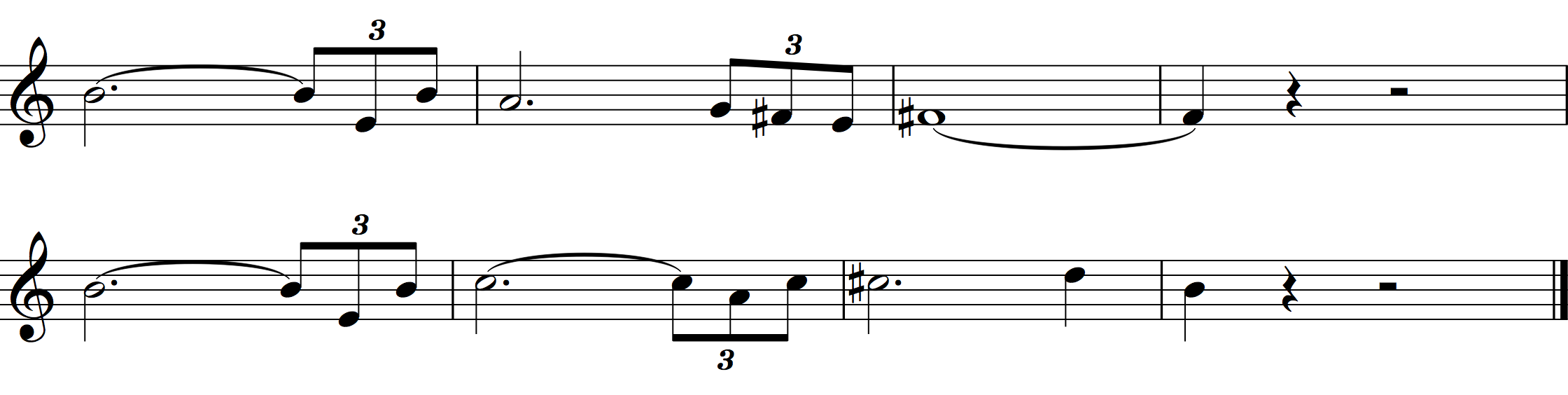
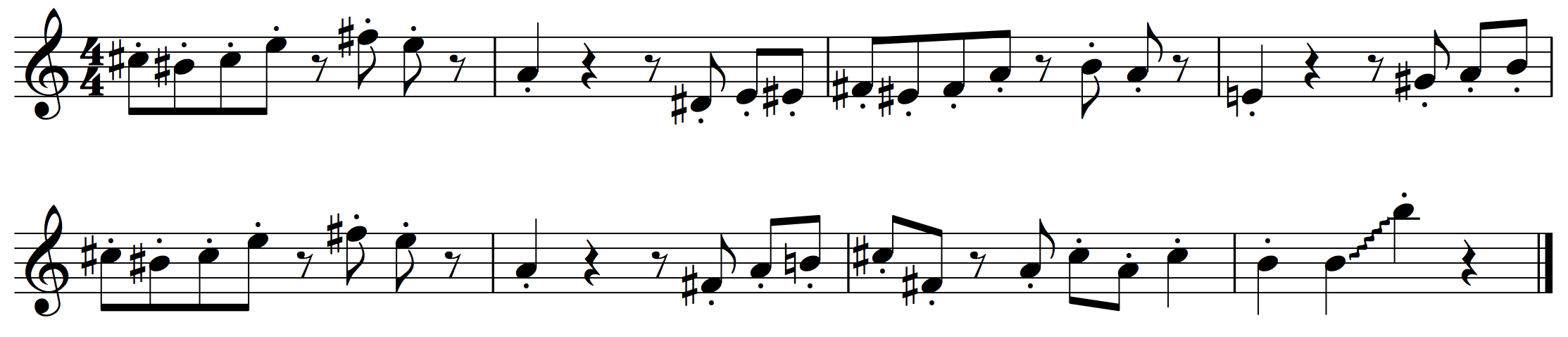
We begin with a solo cello introducing the elegiac main theme, as if in a personal, private prayer:

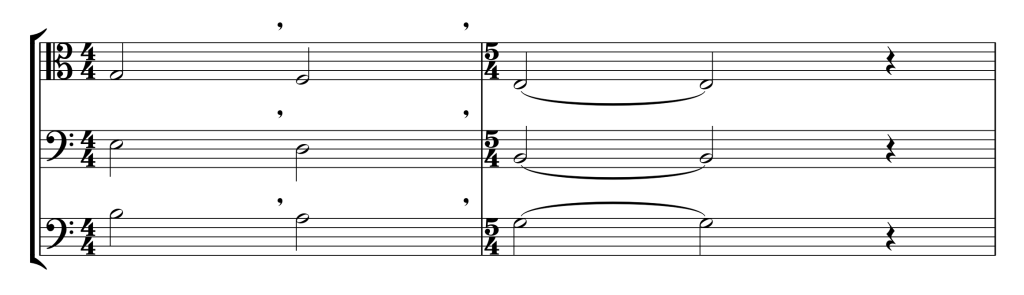
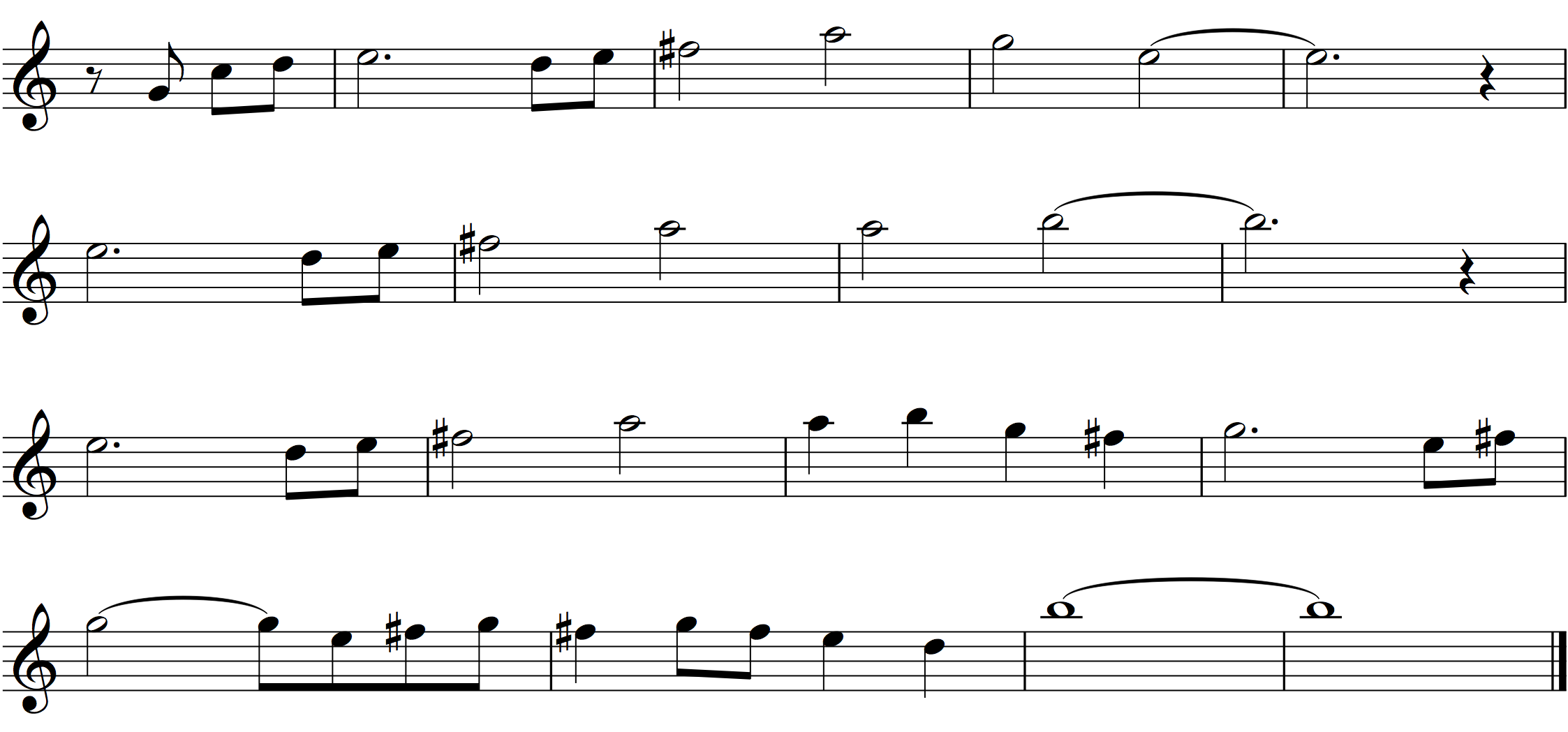
The beginning of the A Theme of In Memoriam. Click to listen.

At first, the melody sounds resolved and self-contained within the first four-measure phrase (beginning and ending on E, the first degree of the scale of our home (or “tonic”) key of E minor). The second phrase takes this idea and builds on it, ending with an unresolved feeling (courtesy of the melody ending on F#, the second degree of the scale; as you will hear in the concert recording, this is supported by a dominant harmony). You may also notice that this melody overall does not maintain a regular time signature, but rather, each melodic gesture flows freely into the next.

If it feels like this melody is syllabic and could potentially support a text setting, your sense is correct. I drew my inspiration for this A Theme (the above excerpt and the rest of the melody that follows) from Lamentations 5:21 (“Take us back, O Lord, to Yourself, and we will be restored; renew our days as of old!”) — more specifically, the Hebrew text: Hashivenu, [Adoshem] elecha, vena shuva; chadesh yameinu kekedem.

The free-flowing opening phrase functions almost like the incipit of a chant, as if inviting the congregation to join in with a reply. Accordingly, the rest of the strings enter with harmonic support during the second phrase of the above melody, as if more voices are being raised to support our cello soloist.

A Theme, Part II

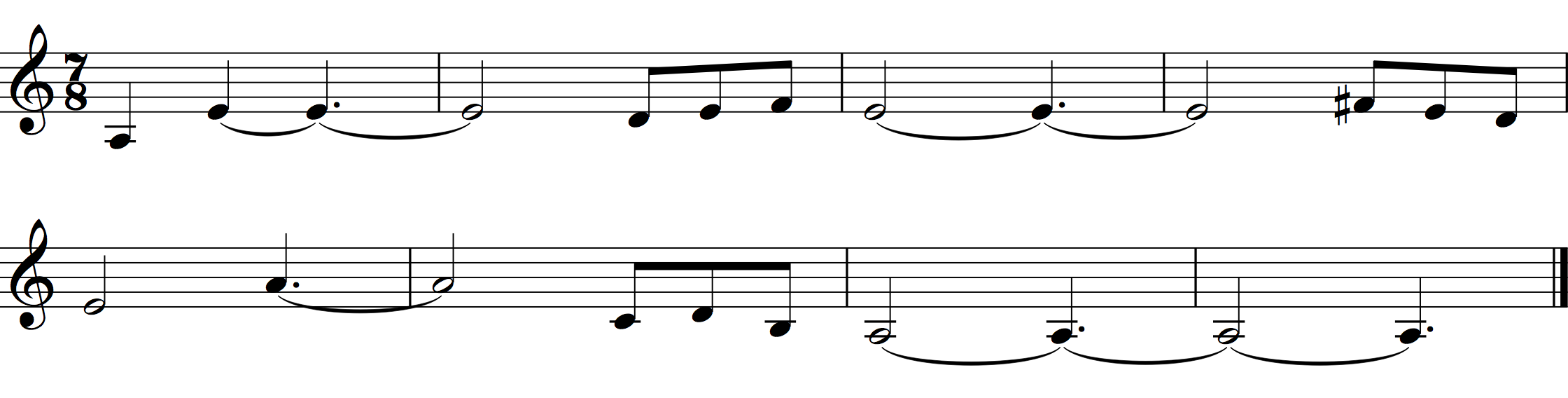
The first violins take over the melody, and, supported by the second violins, violas, celli, and horns, extend this initial idea into a new melodic phrase:

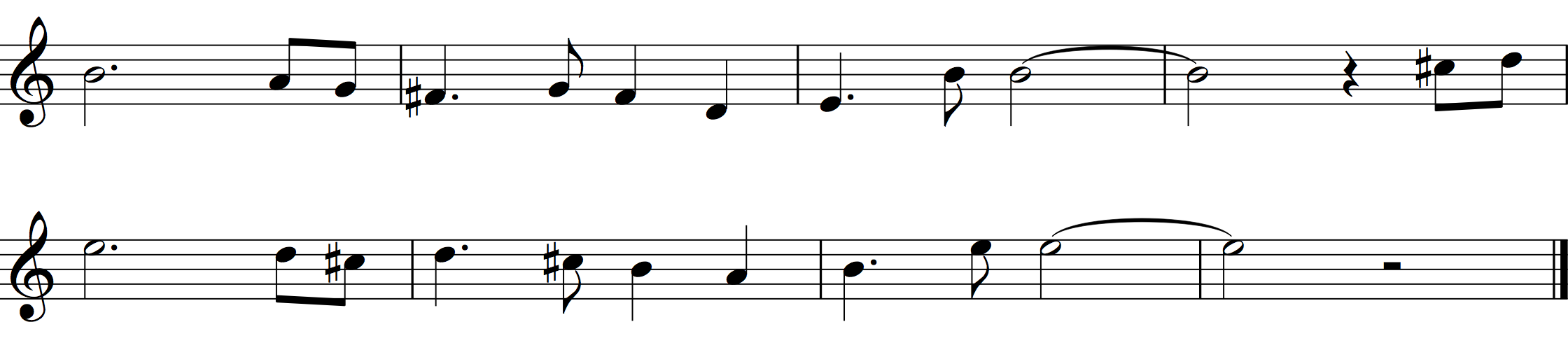
The second motivic idea in the A Theme. Click to listen.

As you may hear, this second phrase also ends unresolved, with the melody ending on the 5th degree of the scale (supported again by a dominant harmony). The more theory-minded of you may also realize that the first and third bars above outline F major (reinforced by the harmony, which you will hear in the concert recording), which is not within our tonic key of E minor, but is a tritone away from the phrase-ending dominant of B major (pay attention, class; this comes back later). My use of modal mixture, hopeful and uplifting as it might sound, begins to destabilize our harmonic centre, if only temporarily.

We then return to the beginning with a repeat of the main theme in the woodwinds, with the strings providing harmonic support. Specifically, I call for the alto flute, the English horn, and the second clarinet in unison, together with the second bassoon an octave lower, all essentially in one voice. That we hear this played by a quartet comprised of the second or auxiliary players, rather than the more soloistic principal players, indicates that this statement of the melody is intended as an echo of what we just heard in the solo cello (behold the power of orchestration!).

The principal players get their due in the next phrase as the texture grows into the full woodwind choir, in a lush and rich chorale-style harmony, supported by horns and strings. The solo cello also returns with a heartrending countermelody, waxing larger and louder to a moment featuring the full orchestra for the first time.

After this miniature climax, I shrink the texture immediately to create a more intimate, introspective moment as the strings repeat the second part of the melody, featuring the second violins, violas, and celli in close harmony while the first violins gently soar on top. This is followed by a little echo in the rest of the orchestra.

A Theme, Part III

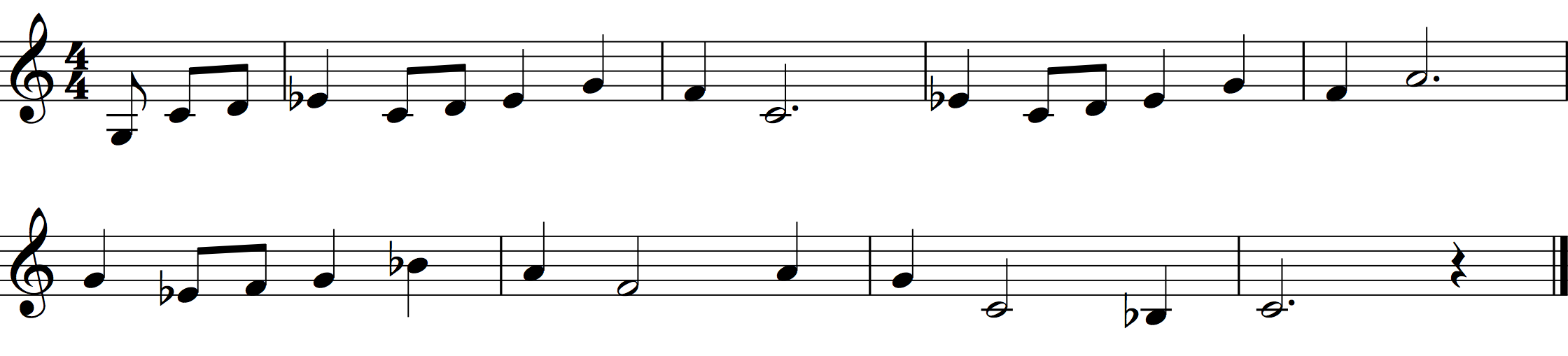
The third phrase of the A Theme. Click to listen.

We then head for the final strain of the main melody, led by the solo cello playing high up in its tenor range. As you may hear, we finally reach a melodic resolution (ending on our tonic note of E) — though not quite a harmonic one just yet.

This idea is repeated and developed by the strings and woodwinds, with melodic variation expanding the range and scope… and then, before we reach the end of the melody and a satisfying conclusion, the tone of the piece turns darker, as if a distant memory stirs. Fragments of the melody echo through the orchestra, alternately mysterious, mournful, and martial. As we go deeper into the memory, the soundscape transforms to a sombre, funereal march beneath calls of pipe and horn, modulating from our home key of E minor to the harmonically distant key of B-flat minor (which is a tritone away! Aren’t you glad you paid attention? 😉).

A New Theme Emerges

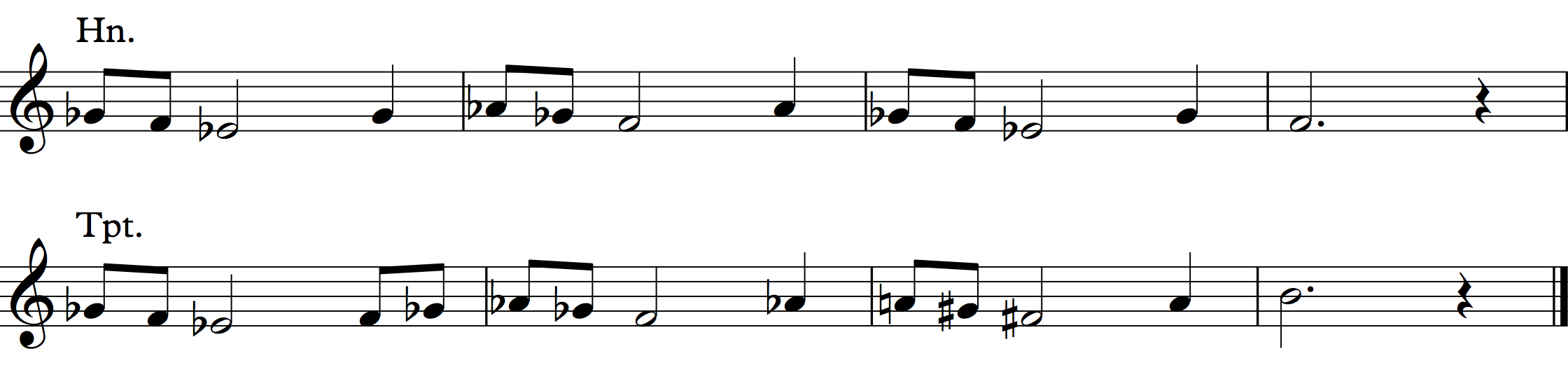
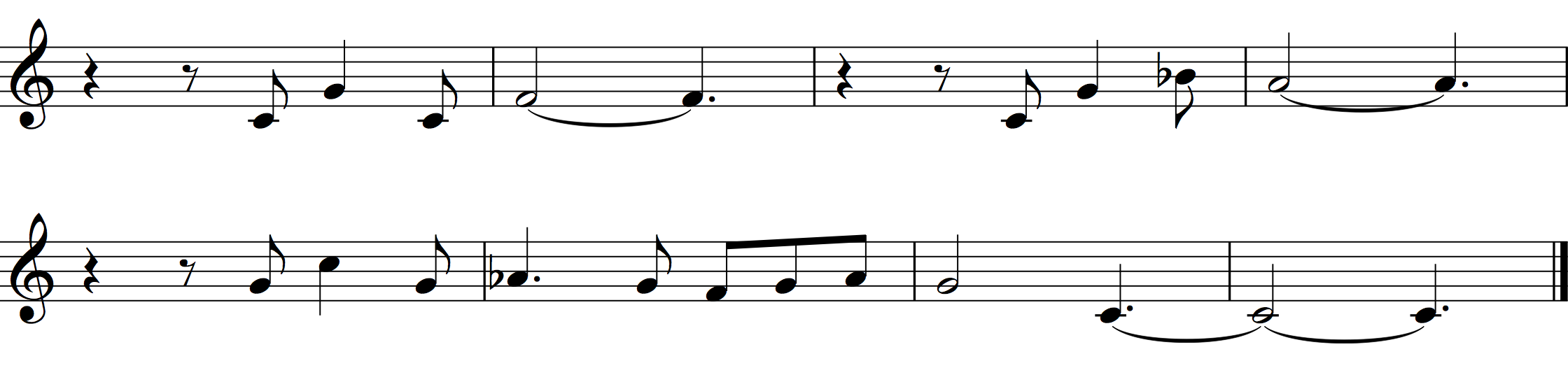
The B Theme. Click to listen.

The tension gives way as the core of this forgotten memory unlocks. We hear a new melancholic theme on solo horn, supported by strings, which is then echoed by the choir of woodwinds. While this second theme is similar in its flowing melodic arc, it is more regular in rhythm compared to the principal theme of the piece.

I had been honestly uncertain about pursuing this theme in the context of this piece until I realized that it scanned fairly well with the text of the (admittedly less-performed) final verse of the Book of Lamentations: “For truly, You have rejected us, bitterly raged against us” (or, in Hebrew, Ki im-ma’os me’as’tanu, qa-sap’ta alenu ad-me’od).

Our solo cellist returns, ruminating on this new theme, which leads to a cascade of repetitions as the melody swirls through the orchestra, growing in volume and mass each time. As the orchestra rages its way through a series of harmonic modulations, the solo cello bursts forth, overcome with emotion, shouting the initial motif of the A Theme with passionate fervor.

Coda

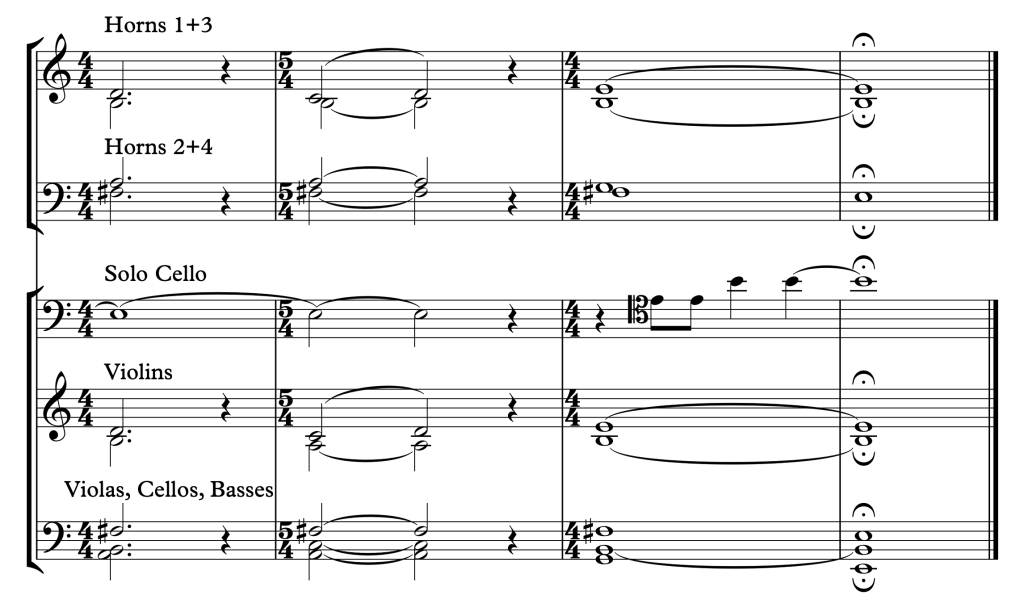
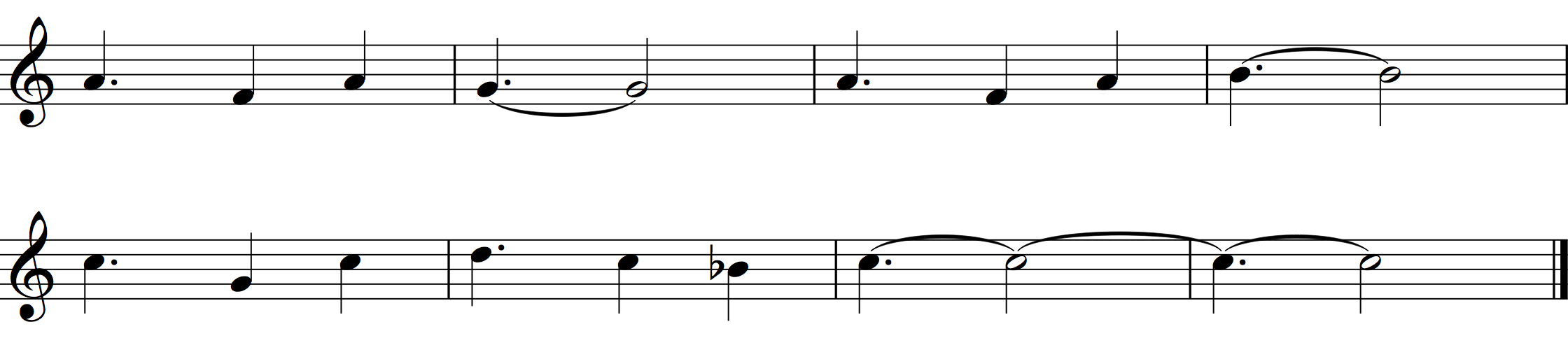
The lower strings set the tone for the coda section. Click to listen.

We snap back to the present moment, where we are left with a raw feeling of loss. The piece concludes with the lower strings in close harmony presenting a slow, three-chord, cadential sequence, back in our original tonic key of E minor. Space is left for a melody that remains conspicuously absent. We repeat the chords, and we hear the echo of the first motif of the piece, now in a quintet of second and auxiliary woodwinds:

The initial motif of the piece returns in the woodwinds. Click to listen.

We play the chords again, thickening the texture with the second violins, with the first motif echoed by a trio of two horns and a trumpet. The first violins join on the fourth repetition of these chords as the solo cello leads us to a quiet conclusion and one final statement of the initial motif.

…and let us say, “Amen.” Click to listen.

I had my first draft of the score finished by the beginning of November. After pouring out every last ounce of emotion onto the page, I was overcome with an overwhelming feeling of emptiness. In the face of global events, despite the copious tears shed while writing, my piece suddenly felt at once apt and yet sadly insufficient.

Had I done enough? Was it even interesting? Would it connect with the audience?

All that was left to do was prepare the piece — and myself — for our journey to Seoul for the concert premiere on December 12, 2024.

To be continued… / 계속…

Are there any other aspects of the composition you’d like me to expand on? Let me know in the comments below!

Ten Years Ago…

Ten years ago, I received an e-mail that changed my life.

I had been anxiously awaiting this date for months, knowing that a very important decision would be handed down. However, the business day came and went, and the message I had been expecting did not materialize. I was puzzled, if not a little dejected.

I went to my usual weekly taiko drumming practice, putting the fact that I hadn’t heard anything out of my mind. Around 8 p.m., while I was swapping out one kind of bachi (drumsticks) for another, I felt an odd tingle ripple through my body, and found myself strangely reaching for my phone, which was nestled deep in my bag. I realized what I was doing, and quickly admonished myself to snap out of it; I was there for taiko, and my phone could wait. I’ll tell you, it took every ounce of discipline to remain present during the remainder of our rehearsal. 😉

Of course, after our practice had concluded half an hour later, I raced for my phone and saw that there was a new e-mail waiting for me — with a timestamp of 8:01.

From: Berklee College of Music, Valencia Campus

Subject: Your Admission Decision

“On behalf of the President and Board of Trustees of Berklee College of Music, I’m very pleased to inform you…”

I had to read the message three times, read it out loud to the others in the room, and pass my phone around to show them the e-mail just to make sure that I wasn’t hallucinating.

It took me about 20 minutes to come down from the joyous freakout born of receiving this incredible news. It was real. This was happening. In little more than three short months, I would be winging my way to Spain to give my career as a screen composer a much-needed boost.

Even though I certainly feel the distance of the intervening years (especially the haze of the last four), my heart still flutters to think back on that day, as well as to all of the memories I made during my year as a Master’s student at Berklee in Valencia. I remain grateful to have received that opportunity and all of the training that has since stood me in good stead since then.

So, I Orchestrated a Musical… (Part IV)

When last we left off, Toronto Fringe had just announced a return to an in-person theatre festival in the summer of 2022. Almost a year and a half had passed since the four-song demo version of Back and Forth: The Musical streamed as part of the Toronto Fringe Collective, the festival’s response to the shuttering of live stages as a result of the global coronavirus pandemic.

Ten songs out of twelve had been arranged, I had ideas for the overture and curtain call, and Dayjan was revising the ending of the show. We were in early negotiations with a venue about staging a live, in-concert reading of the music from the show, which we would later parlay into our rehearsal site for the entire process.

Only one thing was missing: our cast.

2022 or Bust!

In the spring of 2022, we officially extended an offer to all members of our 2020 company to return to the fold for our upcoming production. As Toronto Fringe indicated that there would be no further deferrals or extensions — on top of which a direct scheduling conflict arose with Winnipeg Fringe — this would be the sole opportunity to perform, at least for now. Declining this opportunity after all this time was untenable for us, but for our cast, two years’ worth of life had happened; some were no longer residing in the Toronto area, whereas for others, ongoing concerns about the pandemic loomed too large for performing live to be a viable activity.

Unfortunately, we could neither project what the state of COVID would be in Toronto that coming summer, nor could we fully promise what protective guidelines might be in place at any of the venues, especially with regard to audience members. We respected that people’s comfort levels would be tested throughout this process, and made assurances over what we as a company could control. In the end, however, we had to replace all but one cast member.

With rehearsals set to begin in April, a fresh set of casting calls went out in March — essentially picking up where we left off two years prior. We shared a wry chuckle at how self-tapes had become de rigueur, wheras they had been the exception for a couple of callback candidates back in February of 2020. Considerations were different now: prior concerns about sacrificing a month for our show in both Toronto and Winnipeg were replaced with ones of COVID safety. Response from candidates felt sparse compared to the legions of applicants we auditioned in the Before Times; we were effectively shaking a dormant industry awake, and the festival in July would place us among an early wave of live theatre returning to Toronto.

In the meantime, I rebuilt the arranging template for the last remaining numbers on my new scoring computer! While my old, pre-Retina MacBook Pro — the last of its kind, purchased in 2013 shortly before I began this blog in the first place! — was still technically functional, the proverbial “money light” was coming on most fiercely during my slate of work in the fall of 2020. With the workhorse of a laptop showing its age (and a lucky bout of work coming in at just the right time), conditions were finally right to upgrade both hardware and software. I took the new system, a 2019-model iMac, on a shakedown cruise with a video game score, which spanned from the late summer of 2021 to the early spring of 2022, conveniently wrapping up in time to turn my attention back (…and forth?) to Back and Forth.

I tested the new template on the overture, translating what I had vocalized to Dayjan a few months prior, note for note, into a proper, usable format. The “Procrastinatory Overture” was energetic and animated, influenced by cartoonish ragtime and frenetic conga, and introduced the melodies to a number of songs, primarily “Back and Forth,” the Swordsman theme, and “Time for Me.” While fewer musicals in contemporary theatre maintain a traditional overture (a custom that dates back to the 17th century) and instead launch directly into the action, this was conceived as a choreographed prologue, serving as a prelude to the show and to introduce the alternately playful and antagonistic relationship between Cass and the Procrastination Fairy.

With my new virtual ensemble tuned up, we were ready to welcome a stellar collection of cast members to fill every role… except for one.

Cass-ting Decisions

As in 2020, finding the right person to play Cass was of paramount importance, and similar to our prior experience, we came very close to landing the perfect candidate. By this time, Dayjan had reluctantly resigned himself to portraying a role in his own show, and was ready to don the wings of the Procrastination Fairy, in addition to sharing directorial responsibilities with Alanna. He remained adamant that someone else should play the lead.

While we had a viable alternative for the Fairy in our cast already, we had no one who fit the bill to play Cass — and with our rehearsals scheduled to commence in less than two weeks, we were quickly running out of time. After much soul-searching and, ahem, back-and-forthing, Dayjan concluded that, given the circumstances, he would step into the role. While he would retain creative control over the show, he would call upon me and Alanna to more directly oversee the music and the stage, respectively.
With our cast now effectively filled, we set the date for our table read… and realized that we had two songs left to finish.

I spent early April working overtime to complete the eleventh and twelfth songs: an expanded version of the theme from The Swordsman to represent the full pitch for the animated series, and the grand finale (and longest song in the entire show), “All This Time.” However, since these two songs had been revised since Dayjan’s round of vocal demos in 2020, we had to adjust our workflow. In a departure from our previous practice, we had the opportunity to collaborate directly (albeit remotely) on crafting the vocal scores for these songs together, in order for me to have a roadmap for my arrangements. With our table read fast approaching, there wasn’t enough time for Dayjan to record new vocal demos; I would have to imagine them.

After having been away from the project for more than a year — arranging “The Mission” at the end of 2020 was one of the last things I did on my old system — returning to it felt strange, like I was coming home to someone else’s house. I tried so hard to recapture the momentum that we had two years earlier, and if I’m honest, I never truly felt like I got there. Despite my faster, more efficient computer, I felt that I had become slow, my writing stodgy and clumsy. Yet, in spite of feeling rusty and out of practice, I managed to go from completing the vocal score of “All This Time” with Dayjan to having the arrangement fully realized all in one final three-day push.

About 15 hours later, after I put the finishing touches on the updated piano/vocal score, the cast of Back and Forth: The Musical finally met in person.

Members of the cast and creative team gather for Back and Forth: The Table Read.

Rehearsals

On April 10, two years to the day since our virtual read-through with our original 2020 cast, we officially began the rehearsal process for our 2022 Toronto Fringe production with a live table read. This was a major milestone for the company, and while the real work still lay ahead, the preliminary sing-through gave me a tremendous sense of relief. Admittedly, I had become so accustomed to listening to the music from the show as an album over the course of those two years that I had almost forgotten that there were, in fact, scenes in between those songs!

However, to Dayjan’s credit as a writer, so much plot and character development occurs within those songs that one could listen to just the musical numbers alone and still have a strong grasp of the narrative. My role as music director, in addition to teaching the songs to the cast and helping them interpret the music in accordance with Dayjan’s vision, was to instill in them an understanding of the intention and subtext contained within each musical number, laying the foundation for characterization that Alanna could later work with, build upon, and refine.

With less than three months between our table read and our premiere at Fringe, and out of respect for the schedules (and lives) of our cast and crew, we operated on an incredibly compressed rehearsal timeline. Our initial six(!) rehearsals were dedicated purely to vocals as we hurtled headlong towards our first checkpoint, our long-awaited public showcase.

Perhaps the greatest challenge that we faced during our vocal rehearsals was that, in accordance with our company’s COVID safety protocols, we were singing while wearing protective masks. While primarily designed to inhibit the spread of droplets and particles, we found that our personal protective equipment also expertly filtered sound, which forced us to work harder to overcome the diminished projection and muffled diction. With Fringe’s assurances that masking would be mandatory for audiences, we had planned from the beginning to perform unmasked, with our cast’s voices enhanced with a set of radio microphones, mixed live against my backing tracks by our sound designer, Adam Borohov.

Rehearsing masked, in addition to being for safety reasons, was effectively the vocal equivalent of training with added weights, with an end goal of enabling our singers to relax and perform comfortably once on stage. However, in early June, during our technical walkthrough of the venue, we were informed that having a second technician to mix our sound live, even if we provided our own, would be prohibitively expensive. With this sudden change in our technical plan, we could see that all of those weeks spent training our performers to access that extra ounce of vocal strength and clarity of diction would pay off.

I (at right) direct (L-R, on stage) Ben Skipper, Dante Toccacelli, and Dayjan Lesmond in rehearsal. Photo: Madeleine Monteleone.

Back and Forth: The Musical: In Concert: For Real

A mere five weeks after our first read-through — because there’s nothing like a hard deadline to give you that extra motivation! — the cast of Back and Forth took the stage in front of a live audience to sing through the show in a concert setting, accompanied by the full show’s worth of backing tracks. Presented as a work-in-progress and a promotional stop on the road to Fringe, the audience was introduced to our concert cast, featuring Dayjan Lesmond (Cass), Dante Toccacelli (Procrastination Fairy), Nikki Haggart (Ace), Georgia Grant (Dr. Grace), Ben Skipper (Ben), and Maria Kapoglis (Ensemble). For my part, I was thrilled at the dedication and professionalism shown by the cast in learning the material — over 20 minutes of music for a 45-minute show — so well in such a short period of time.

With the notes under their belt, we could confidently proceed with our next slate of rehearsals dedicated to scene work, blocking, and choreography, headed by Alanna. I remained on-hand to maintain the quality of the cast’s vocals, and to supervise the placement of the cue-in points of each song, working with the team to ensure that we transitioned into each number at the appropriate dramatic moment. Week by week, scene by scene, the show took shape.

Alanna O’Reilly (standing, at left) directs (L-R, on stage) Dayjan Lesmond, Nikki Haggart, and Dante Toccacelli through a scene while Madeleine Monteleone (seated, at left) looks on.

Meanwhile, I wrote two underscore cues, based on Dayjan’s melodies from the show, to facilitate certain scene transitions. As with my arrangements for the songs themselves, I held myself to a strict rule for these cues not to foreshadow or quote any themes or motifs that had not yet appeared in the score, to ensure that we preserved the dramatic impact of hearing those themes in their proper context. These cues effectively functioned as playoffs, as they were based on the melody of the preceding song, but I took the opportunity to reimagine them in the dramatic context of the moment. As we neared our final rehearsals, I arranged the music for the curtain call, finally giving a proper voice to an idea I’d had two years earlier (which we heard in a hilarious rendition by Camille Holland at the end of Back and Forth: In Quarantine).

We welcomed three new cast members through the latter half of the rehearsal process: Josh Alcantara (Ensemble) joined us immediately after Back and Forth: In Concert, and Mercedes Ranjit (Ensemble, replacing Maria Kapoglis) and Mateo Chavez Lewis (Ben, replacing Ben Skipper), joined us in June. We held one more edition of Back and Forth: In Concert as part of an outdoor performance about two weeks before we were scheduled to open at Fringe. By the time of our technical rehearsal and final run-throughs, we were ready and eager to take the stage.

…but before we get to Fringe, let me tell you more about the show itself!

Plot Synopsis

Cass is an artist who has been given the opportunity to pitch their animated series, The Swordsman, to a room full of network executives at the highest level, courtesy of their agent, Ace. On the morning of the presentation, however, Cass scrambles to finish (“PROCRASTINATORY OVERTURE”). Even though Cass pulls off a good performance (“THE SWORDSMAN PITCH”), Ace calls them out for having recycled their previous pitch from four months prior, and demands to know what they have been doing instead of working (“BACK AND FORTH”). Ace gives Cass an ultimatum: deliver a new pitch in three days, or she walks. Cass tries to get to work, but finds themself increasingly subject to distractions, culminating in an all-night video gaming session with their best friend, Ben (“BOSS FIGHT!”). At sunrise, as Cass finally logs off to go to bed, the Procrastination Fairy reminds them that, even while asleep, they always make “TIME FOR ME.”

The Procrastination Fairy (Dante Toccacelli) strikes a pose with their minions (Mercedes Ranjit and Josh Alcantara) as Cass (Dayjan Lesmond) tries to sleep. Photo: Brandon Goncalves.

The next day, Cass confides their insecurities in their therapist, Dr. Grace (“YOU’RE ENOUGH”). Feeling better about their trajectory, Cass tries to get back to work, but is again distracted by Ben, who wants to play for the second night in a row. Cass declines, and they have a falling out (“FINAL BOSS FIGHT”). Just as Cass settles down to work, the Procrastination Fairy reappears as a distraction, conjuring visions of Cass’ friends and associates to taunt them (“NOT GOOD ENOUGH”).

Cass (Dayjan Lesmond) is taunted by the voices in his head (clockwise, from lower left: Nikki Haggart, Georgia Grant, Mateo Chavez Lewis, Josh Alcantara, Mercedes Ranjit, Dante Toccacelli). Photo: Brandon Goncalves.

Day Three. Cass has almost started working on the pitch when Ace checks in. Thoroughly unimpressed by their lack of performance, she fires Cass as a client (“WE’RE DONE”). Both Ace and Cass, frustrated and in despair, respectively seek therapy for these recent developments (“I’M A MESS”). Dr. Grace suggests that Ace would benefit from a vacation, and gives Cass guidance on how to better focus. Cass, filled with purpose, spends the following week buried in their work, and writes a new pitch for The Swordsman, despite the Procrastination Fairy’s repeated attempts at distraction and sabotage (“THE MISSION”).

With the pitch now complete, Cass and Ace reconcile. Cass delivers their new, fully fleshed-out pitch for their show (“THE SWORDSMAN COMPLETE”). The pilot for the series is greenlit, and Cass resolves to move forward with a healthier, more balanced relationship between their work and their friends (“ALL THIS TIME”).

The cast assembles for the grand finale (L-R: Nikki Haggart, Dayjan Lesmond, Mateo Chavez Lewis, Theodore Dragon, Dante Toccacelli, Josh Alcantara, Georgia Grant, Mercedes Ranjit). Photo: Brandon Goncalves.

FRINGE!

Almost three years (and one pandemic) since Dayjan first put pen to paper, we were about to see Back and Forth take form, live on stage at the Factory Theatre in downtown Toronto. Our first performance was scheduled for a matinee on July 8, the third day of the festival. Giddy with nervous anticipation, Dayjan and Dante took the stage in their respective roles as Cass and the Procrastination Fairy, with the rest of the cast waiting in the wings. The frisson in the air was palpable. The opening notes of the overture rumbled through the theatre, and…

…the lighting system failed.

The beauty of live theatre, as in life itself, is that one never knows just what will happen. The lighting board at the venue froze, and half of the lights in the rig, meticulously designed and programmed by our lighting designer, Brandon Goncalves, failed to respond. Conditions on stage suddenly became less safe as whole scenes were played in darkness. Halfway through the show, the in-house technical team in the booth raised the house lights as they scrambled to engineer a hotfix without pausing the performance. Shortly before the number with the most demanding lighting cues, “I’m a Mess,” the house lights were lowered again. We held our breath, waiting for the moment of truth, and the stage positively glowed with Brandon’s design.

It is absolutely a testament to the training and professionalism of the cast that they were able to keep performing through the technical malfunctions. The house technicians assured us that these problems would not recur, and we looked forward to mounting our second performance, with the lighting as intended, two days later.

In the meantime, I had been planning three more underscore cues to facilitate additional scene transitions. I hurried to finish them after our opening performance, rationalizing that much larger shows undergo more substantial changes during their runs (especially during previews). I handed off the files to our stage manager, Madeleine Monteleone, to quickly import into our show session (on top of guaranteeing the integrity of the lighting program with the house technicians) during our scant minutes before the house opened for our next show. With all of the lights and sounds in their proper place, I am happy to report that the strength of our second performance more than made up for our opening.

Once all of the technical issues were sorted out over the next couple of performances, the rest of the run went by in a blur. Equal parts exhausted and relieved, we bowed after our seventh performance, as scheduled, on the closing day of the festival. For what was effectively a first workshop of Dayjan’s first musical, especially considering how ambitious it was, I would say that our run went fairly well overall. There was much that we all learned from the experience that we hope to apply to future projects going forward, both for new musicals and an anticipated expansion of Back and Forth into a full-length production.

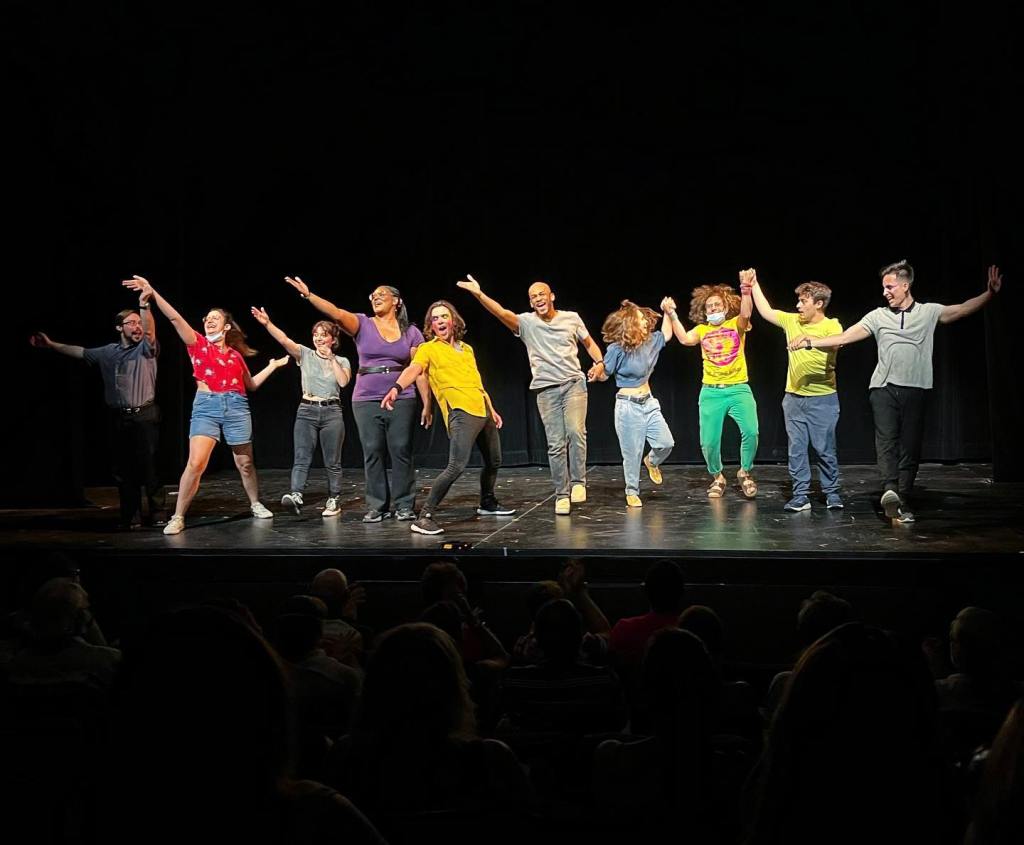
Team Back and Forth takes its final bow. L-R: David Federman (arranger/orchestrator/music director), Alanna O’Reilly (choreographer/associate director), Mercedes Ranjit (Ensemble), Georgia Grant (Dr. Grace), Dante Toccacelli (Procrastination Fairy), Dayjan Lesmond (music/book/lyrics/director/Cass), Nikki Haggart (Ace), Adam Borohov (sound designer), Mateo Chavez Lewis (Ben), Josh Alcantara (Ensemble).

So, Is This What You Do Now?

Along with a host of other things that I do in the realm of media and concert music, I suppose that the staging of Back and Forth means that arranging/orchestration for musical theatre can now be added to my list of composer-adjacent skills. However, composing remains my first love, and even though I have been on a hiatus from writing for much of this year, I am already returning to the composer’s chair with a slate of upcoming scoring projects.

…and who knows? Maybe I’ll end up writing a stage musical of my own someday. Dayjan made it look like so much fun. 😉

Acknowledgements

I would like to extend my heartfelt gratitude to the members of the Back and Forth family whose efforts have made these iterations of our show possible: Kimberly Ramón, Camille Holland, Rosie Callaghan, Elizabeth Rose Morriss, Taryn Wichenko, Chihiro Nagamatsu, Rev. Brian Stevens at Hope United Church, Olivia Esther, Dante Toccacelli, Nikki Haggart, Georgia Grant, Ben Skipper, Maria Kapoglis, Mercedes Ranjit, Mateo Chavez Lewis, Alanna O’Reilly, Madeleine “Monty” Monteleone, Brandon Goncalves, Adam Borohov, Ross Hammond, our venue technicians, the supportive team at The Toronto Fringe…

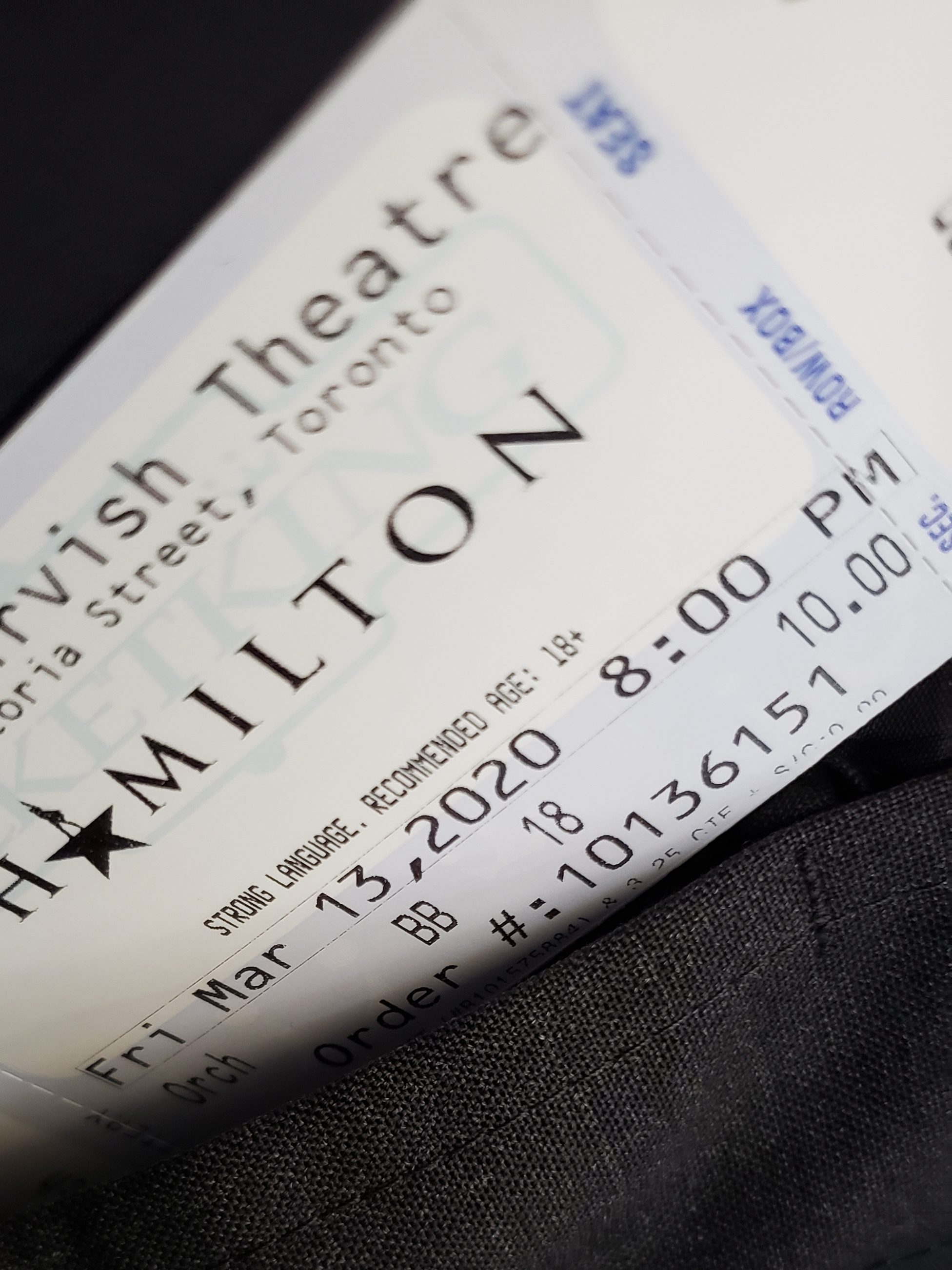
…and, of course, to Dayjan Lesmond, whose dream of dragons finally took flight. Thank you for trusting me with your vision, for letting me help you find your sound and tell your story, and for allowing me to be the Hamilton to your Washington.

Back and Forth: The Musical © 2022 Nightjan Productions. All Rights Reserved.

So, I Orchestrated a Musical… (Part III)

When last we left off, the creative team of Back and Forth had fully taken shape, two-thirds of the songs in the show had been arranged, our cast was all but finalized, and we were soon to begin rehearsals when the outbreak of the global coronavirus pandemic forced an abrupt shutdown to everything.

We, along with everyone else, remained hopeful that we would be able to get back to work after a brief pause, but as the weeks dragged on, only one thing became clear to us: live theatre as we knew it was on hiatus.

Indefinitely.

I tried to look on the bright side: with my weekly commitments and other gigs having been cancelled, I suddenly had all the time in the world to plow through the remaining arrangements for the show. I had already worked them out in my head; all I had to do was sit down and…

I just… couldn’t.

We all deal with pain in our own way, dear readers, and unfortunately for me, the onset of the pandemic cast me back a year to when I was freshly injured. After having just spent 13 months “adjusting to the new normal” and being largely isolated due to my brain injury, the global trauma that we experienced in March of 2020 felt all too familiar: the sudden impact, the uncertain severity of symptoms on any given day, the unknowable prognosis, the allostatic overload — the similarities were nothing short of overwhelming. On top of that, this represented the third time in as many years in which my ability to play music with others, live and in-person, was suddenly taken away, which was an injury on the soul level. Then came the grief — the bereavement for everything that I had been looking forward to doing — now renewed for a second straight year.

I know that this is relatable to many of you, and I want to believe that if I had any resilience to spare after that first post-concussion year, I might have been able to respond more deftly to the rapidly-evolving situation. Instead, feeling thoroughly retraumatized, I fell into a depressive episode, the acute phase of which lasted for two whole months.

Hilarious.

In that time, I kept creating — little things, mind you, hardly any magnum opus — but honestly, even though much of what I wrote, arranged, or produced was intended for the benefit of others, it did nothing to alleviate the overwhelming feeling of pointlessness. Even if it was vaguely amusing to learn that my normal composerly lifestyle looked indistinguishable from quarantine at the best of times, it required that my collaborators, be they on film sets or in studios, be allowed to go about their work unimpeded; work-from-home equivalents ranged from unwieldy to impossible. During this time, for many of us in the arts sector, not only were we unable to continue doing what we had spent our lives training for, but we were actively prevented from doing so.

After having clawed my way back to almost being ready to attempt living and working somewhat normally again, I was once again knocked into crisis mode and focused heavily on survival; creating anything at all, never mind anything of substance or significance, was of much lower priority for me. Truth be told, the only thing that the pandemic inspired in me was an identity crisis: if creating wasn’t my top priority, was I even really an artist anymore?

To keep our spirits elevated, the creative team of Back and Forth stayed in touch by video chat on almost a weekly basis, but reassuring words, amusing video filters, and funny memes did little to cover for the fact that we were, at best, adrift. Contrary to the platitudes at the time, we were not all in the same boat, but the same storm, and I was drowning.

Just Keep Swimming

A few weeks into the shutdown, with Fringe yet to make a decision about whether they would commit to holding a festival of any kind, we were resolved to remain as focused as we could, and continue to work as if our 2020 festivals were going ahead until we were told otherwise. We invited the cast and crew for a virtual table read, which would also serve as a de facto meet and greet; doing so through the confines of our screens was less than ideal, but we felt that we had no better, safer option.

Three days before our scheduled table read, Toronto Fringe officially announced its cancellation.

By that time, it had seemed inevitable, but we went ahead and ran our cast and crew meeting anyway. The company gathered online, with the cast reading the script and listening to the eight arrangements that I had completed to that point (and to Dayjan’s rough sketches for the remainder). We made notes and discussed revisions based on our impressions from the table read. We were committed to continuing the work… even if it would be a while before the world would get to see what we were working on.

Fortunately, a few weeks later, Toronto Fringe contacted us with an invitation to prepare a short prerecorded presentation for inclusion in a digital festival, slated for streaming that summer! The Fringe would go on! We would have a platform to show something after all! The content of this virtual offering, they explained, did not have to be connected to our intended Fringe show, but we figured that since we had a cast, a script, and songs (with screen-ready backing tracks, even!), the potential to showcase some of the above as an early work-in-progress demo was too good to pass up.

The call to participate in the online Toronto Fringe Collective was enough to transition me out of my funk and back to work on the next song in my docket: a Latin-influenced mental breakdown conga called “I’m a Mess” — something to which I believe we could all relate at that time. I thought back to my year at Berklee in Valencia and getting to meet, work with, and learn from a host of musicians from the Latin music world. As always, drawing on what I knew (and reminding myself with research just to be sure), I took great care to render the tumbao rhythm just right, and I delighted in teaching Dayjan a thing or two about things like clave and groove. (By all accounts, I almost seemed cool. 😎 )

Back and Forth: In (Virtual) Concert

We put out a call amongst our cast to gauge interest in this new opportunity, and most of our cast members were as eager as we were! In response to the five who stepped forward, Dayjan and I began our preparations for what we initially styled as Back and Forth: The Musical: In Concert. First, we would need to adjust the script; since we no longer had our hour-long time slot of the live festival, nor did we have our full complement of cast, telling the full story of Back and Forth would have to wait. Instead, we decided to make our prerecorded performance more applicable to what we, as artists, were going through during the pandemic, filmed and edited in the style of video calls. Some scenes and ideas from the full show were retained, but we otherwise considered In Concert to be a separate entity in the BackandForthiverse.

In parallel with the script redevelopment, we chose four of our favourite songs from the show, our selections informed by those who comprised our ad hoc cast. We decided to feature “Back and Forth,” “Time for Me,” “You’re Enough,” and my most recent addition, “I’m a Mess.” Making slight adjustments to the piano/vocal scores, we equipped our cast with demo recordings and organized a fresh table read. With barely nine days to our delivery deadline, we asked our cast to record both their audio and their video as quickly as possible, so as to give us as much time as possible to edit everything together.

Our cast dutifully sent video and audio tests for us to review. We were limited in our time and ability to give notes (let alone actually rehearse in real-time with our singers), but our performers handled the task of bringing their self-isolated characters to life with the utmost aplomb.

We’re a Mess… But We Try!

As with everything in the early stages of the pandemic, our objective was to do the best we could with the resources available. Having heard from session musicians who had suddenly been displaced from their scoring stages, I was bracing for all of the difficulties that these professionals had reported with rapidly having had to figure out how best to self-record something that (by dint of enough post-production magic) could be screenworthy. Yes, we all enjoyed many self-recorded performances, with offerings ranging from amateur virtual choirs to Broadway stars, and I can assure you, faithful readers, that they were, all and each, the result of an arduous journey.

In our case, as it would have been unsafe to make house calls to record our singers using professional-grade equipment, and impractical at best to rent a microphone (with or without an interface) to share amongst our cast, we just had to make do with what we had… and summon up as much engineering magic as we could. It was going to be awkward and unwieldy, but we were determined to make it work.

As Dayjan and I emerged from days of round-the-clock editing (with him taking responsibility for the video edit, and I the music edit and mix), we looked forward to two things: working with our amazing cast of talented performers in person the following year, and never having to do a virtual recording project again.

A little more than 3 weeks later, our pandemic-size demo premiered in the Toronto Fringe Collective to great acclaim, featuring the performances of Kimberly Ramón, Rosie Callaghan, Camille Holland, Elizabeth Rose Morriss, and Taryn Wichenko. We would later rebrand it as Back and Forth: In Quarantine, and release it for public viewing on YouTube, which you can see below:

The title screen of Back and Forth: In Quarantine. Click to view (opens in a new tab).

Now What?

We were granted the opportunity for an encore performance, which streamed about six weeks later, and then… that was pretty much it.

We had been guaranteed our performance slot at the next live edition of the Toronto Fringe… whenever that might be. We were optimistic that we would only have to wait a year — which for us would mean enjoying several months of downtime continuing our work on the show before reconvening for rehearsals — but the uncertainty born of new COVID variants surging quelled any enthusiasm that we might have had.

For me, a new slate of projects and responsibilities took over in the fall, which saw me through to the end of the year. In December, I finally had the bandwidth to arrange the tenth song in the show, “The Mission” (the ideas for which I had been holding in since March!). Dayjan, meanwhile, was considering some script revisions to the end of the show, which meant that writing my arrangements of the last two songs would have to wait.

With things looking progressively more bleak as we headed into the winter, and Toronto Fringe being initially noncommittal about their future plans, we fell back into how I essentially approached things from the start: nothing more was going to be material until it materialized. Our hope was not enough to end the pandemic, and having all the time in the world only inspired us to procrastinate (the Fairy would be so proud of us!).

Early in the new year, Toronto Fringe decided that its 2021 festival would be exclusively online. With our hearts set on realizing this show live on stage, we were not in a rush to use up our Fringe slot on another virtual performance. They offered us the option to defer until 2022, and we accepted.

Time Skip!

Things effectively lay fallow until November of 2021, when a dear friend and colleague of mine contacted me with a proposal. She was offering us a venue for a staged reading of the music from Back and Forth, intended to give us some exposure on our road to Fringe. How could we possibly say no to doing a real edition of Back and Forth: In Concert, something that Dayjan had been dreaming of for two years already?

A few days thereafter, with my mind once again in Back and Forth mode, I conceived of a new overture for the show (borrowing from and punching up Dayjan’s sketch from early 2020), imagining Alanna’s choreography and all! Before I could even render it in my audio workstation, I excitedly sang it for Dayjan over the phone. He seemed to like my ideas (inelegantly sung as they were), and granted me leave to properly arrange it at an appropriate time.

About a week later, Toronto Fringe announced its dates for a live theatre festival in the summer of 2022! There were plenty of concerns to go around, not least of which being the projected state of COVID and public health mandates, let alone the logistics of rehearsing and performing safely, but as there were no further deferrals or extensions on offer, it didn’t take much convincing for us to accept.

However, as it was now almost a year and a half since our virtual performance in the 2020 Toronto Fringe Collective, would we still have a cast waiting for us?

End of Act Three

Visit the lobby for some refreshments, and come back next week for Act Four!

So, I Orchestrated a Musical… (Part II)

When last we left off, I had been asked by actor/writer/director Dayjan Lesmond to join the creative team of his new musical, Back and Forth. Through the autumn of 2019, while we awaited the results of various Fringe lotteries, Dayjan sent me preliminary drafts of his first few songs, giving me ample time to sit with the material and to organize the nascent ideas for my orchestrations.

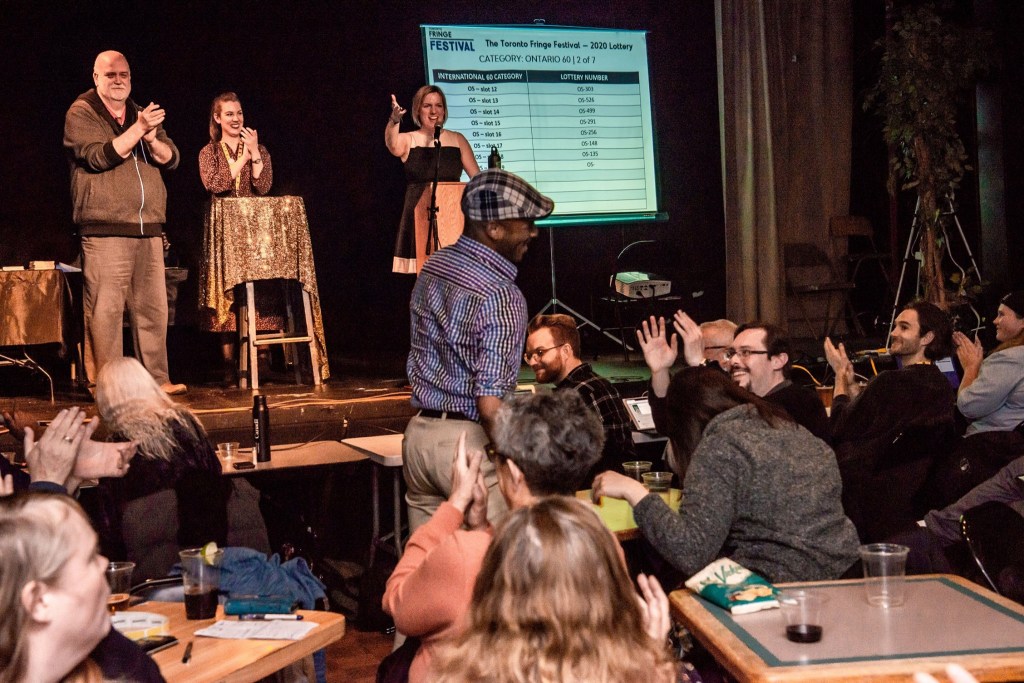
Dayjan Lesmond (centre) greets the applause of the crowd as Nightjan Productions is drawn for the 2020 Toronto Fringe Festival. Photo: Colleen Yates.

On December 3, 2019, our path became clear as we were drawn for the 2020 Toronto Fringe Festival. The Directorial Team, consisting of Dayjan as writer and director, Alanna O’Reilly as choreographer and assistant director, and yours truly as arranger/orchestrator and music director, sprung into action that very night, ducking away to a nearby bar to begin charting a course that would take us through the following months.

With our premiere set for Toronto Fringe, and an encore slated for the Winnipeg Fringe Festival immediately thereafter, my work to help Dayjan find the musical voice of Back and Forth began in earnest.

The Sound of the Show

For me, regardless of medium, the sound of a project works best when it is consistent with the overall concept of the narrative. To list examples from my own filmography, John Lives Again borrowed aesthetics and attitudes from the 1980s, The Suitcase used an internal animated movie as a framing device, and Haru’s New Year captured a yearning for home and the pang of homesickness with a stylistic homage to Japanese cinema; the directors of each asked for my scores to match those concepts accordingly.

In the case of Back and Forth, our protagonist, Cass, is an artist — a writer working on the pilot to an animated series, The Swordsman, which forms the basis of the major narrative through-line of the piece. Animation often lends itself to memorable scores written for large forces (even rendered on virtual instruments in the case of contemporary television), and is perhaps a more forgiving medium for writing music that may seem whimsical, overly emotional, or otherwise over-the-top or on-the-nose; I hold the countless hours I spent as a youngster watching cartoons responsible for having been able to turn out cues like The Frog Chase rapidly (and have fun while doing so!). Cass is also a gamer, devoting their free time to playing epic multiplayer quests with their best friend, Ben — again, another source of memorable music which has also left an indelible imprint on the DNA of my own scores.

Suffice it to say, I understood the sonic world in which Cass was steeped very well.

As I became more familiar with the show overall, I could see that Cass identified very strongly with their work (any resemblance to artists that you may know being purely coincidental, of course) to the extent, in my estimation, that they interacted with the world through the musical-narrative lens of their interests. Further, as my understanding deepened, the concept that drove my arrangements — that not only was Cass well-versed in animation, musicals, and video games, but that this was where they sought refuge and took comfort — grew in parallel.

My understanding and interpretation of Dayjan’s concept for the show — especially because we were representing such lush pools of music as animation and video games — led me to write for a 14-piece pit orchestra in order to adequately cover timbres across all instrumental families: three reeds (with Broadway-style doublings*), four brass, three strings, one bass (doubling upright and electric), one keyboard, and two percussionists.

*In concert music and film score, woodwind musicians, in addition to playing their primary instrument, can be asked to perform double duty by playing auxiliary instruments of the same kind (e.g., a flautist could be expected to also play piccolo or alto flute, an oboist could double on English horn, etc.). However, Broadway wind parts (or “reed books”) commonly have less usual combinations (e.g., a “Reed I” player could be asked to double on flute, piccolo, clarinet, and saxophone all in the same show).

On a Fringe budget and timeframe, having a live ensemble for this version of the show would not be feasible. However, as we considered this to be a proof-of-concept for a larger production in the future, and since Dayjan was satisfied with the sound of the backing track that I had written for “Time for Me,” then rendering the accompaniment on virtual instruments would suffice.

Notwithstanding that if I’m only being asked to produce backing tracks without the need for the music to be performed live, then technically the instrumentation can be whatever I want. However, since our overall ambition for Back and Forth saw Toronto Fringe as a checkpoint, not a destination, my contribution would include planning for the future; if I wanted to have a hope of ever seeing this realized with an ensemble of real musicians, I knew that I had to keep the instrumentation (relatively) manageable and reasonable, and the writing playable and idiomatic.

In the face of shrinking budgets and changing aesthetics, a 14-piece ensemble feels like a luxury. Indeed, the sound of contemporary musical theatre tends more towards adopting a small form-factor for accompaniment. Some of my favourite examples include Urinetown (comp. Mark Hollmann, orch. Bruce Coughlin) with five, Avenue Q (comp. Jeff Marks and Robert Lopez, orch. Stephen Oremus) and Waitress (comp. Sarah Bareilles, orch. Nadia DiGiallonardo) both with six, and Come From Away (comp. Irene Sankoff and David Hein, orch. August Eriksmoen) with nine. Even Hamilton (comp. Lin-Manuel Miranda, orch. Alex Lacamoire) makes do with ten on Broadway (11 when it was here in Toronto) — definitely a far cry from when Phantom (comp. Andrew Lloyd Webber, orch. David Cullen and Andrew Lloyd Webber) opened in Toronto with 29 (plus conductor)!

…and yet, within those orchestrations, you largely find that they are consistent with the show’s concept: Avenue Q contains the core essence of a certain long-running children’s television show, Waitress sounds like what you could fit inside a diner, Come From Away a ceilidh band… and Phantom was the grandeur of the Paris Opera… plus synthesizer and drum machine (okay, so it doesn’t have to be literal).

However, Back and Forth is not a rock musical, neither would a small band or combo match the concept of the show as it stands today. While the balance of pit ensembles is admittedly skewing smaller compared to the mega-musicals of yesteryear, musicals boasting pit complements of around 14 are not unheard of, even among contemporary productions — including one that also got its start at the Toronto Fringe, The Drowsy Chaperone (comp. Lisa Lambert and Greg Morrison, orch. Larry Blank).

This core of 14 formed the basis of our sonic framework. Dayjan further requested that I refrain from the now-standard practice of filling out the more intimate chamber orchestra sound with additional keyboards (to give, for example, the illusion of a larger string ensemble without the need for hiring commensurately more live musicians), and I was happy to agree. As much as I am capable of writing for the sound of 50-piece orchestras (and as much as I’d really like more brass in some of the tunes), this was not the time; we’ll save that for the 25th anniversary concert at the Royal Albert Hall. 😉

Enough Dreaming – Back to Reality!

Our next checkpoint would be our audition process, scheduled for early February of 2020, by which time I would need to produce a slate of arrangements to serve as callback materials for each of our five principal characters. With the Procrastination Fairy’s zany “Time for Me” solo already complete, I set to work on the remaining four: “Boss Fight,” a video game-inspired trio led by Ben, “We’re Done,” a smoky jazz-blues number to represent Cass’ harried agent, Ace, “You’re Enough,” an eleven-o’clock number for Cass’ therapist, Dr. Grace, and “Back and Forth,” the title song of the show itself, for Cass.

However, as I was already working on two films, Joey Boy (dir. Mark Matechuk) and Double Edged (dir. Cliona Concetta), plus finishing the Christmas season as the director of the Rosewood Consort and actively preparing for an ambitious year ahead, all while actively managing the concerns and limitations of my health, I would only have a scant few weeks in which to complete this round of arrangements.

My arranging process for each song remained essentially the same as it had been on “Time for Me” a few months earlier, starting with Dayjan sending me a demo recording of him singing the vocal lines and a rough draft piano/vocal score. I would then study the script to glean insight about context and motivation, and, perhaps most importantly, how the number served to further the plot. From there, I would find musical ways, such as using a recurring instrument, motif, or chord progression, to build characterization and link everything in the narrative together. I would look for lyrics where I could get away with injecting my particular sense of humour, or think of moments that I could set up for Alanna to highlight with her choreography. All of these ideas would inform my musical choices, from the broader artistic strokes of instrumentation and texture to more technical aspects like reharmonization and interpolating countermelodies.

With all of this in mind, I would then craft my arrangements by musically painting around Dayjan’s vocals. As Dayjan himself is an expert singer, his rough vocal demos were not only a delight to work with — even the ones in which he needed to sing outside of his normal baritone register! — but they were also a boon to my process: the ideas he had shared over coffee were suddenly all the more tangible for me, and in turn, hearing his ideas fleshed out with a proper accompaniment (albeit realized with virtual instruments) made this show all the more real for him.

As with “Time for Me,” Dayjan granted me the latitude to go completely off the page and rebuild the accompaniment for each song in the manner that would best express his intentions (within our stated parameters, of course). While Dayjan characterized my process of writing the arrangements as reading his mind, I would tend to describe it more as listening.

I would often let my mind wander to the balcony of some imagined theatre in a hopeful future, in which I could see and hear every detail of the fully-staged Broadway production of Back and Forth. The costumes, lighting, and choreography for every scene appeared in my mind’s eye, and, perhaps more pertinently, every note of the orchestrations resounded in the playhouse of my mind. In the end, as I mentioned in my previous entry, my inspiration largely came from unearthing the core essence of the songs themselves, and, exactly as with my arrangement of “Time for Me,” it felt akin to remembering the music that was supposed to be there; all I had to do was listen.

After completing each arrangement, I would send a new demo recording back to Dayjan, this one featuring his vocals accompanied by my virtual 14-piece pit orchestra, for his approval. Once approved, I would transition from arranger to orchestrator, transcribing my virtual orchestrations into a fully-engraved score to serve as a final proofread of my arrangements. This also enabled me to make decisions about interpretation (such as dynamics, articulations, stylistic markings, etc.) in preparation for a future iteration in which we get to perform everything live; when the time comes, everything will be ready (or, at least, we will have a very good starting point!). More practically, however, the engraved score would form the basis of my last step: translating my arrangement into a piano reduction in order to create a piano/vocal book from which the singers would learn their parts (and from which, as music director, I would conduct the performers in rehearsal).

One arranging decision that I made early on, inspired by the memorable melodies that Dayjan had written for this show (and perhaps influenced by the strength of his demo performances), was to allow the vocal lines to stand on their own, rather than following the time-honoured practice of having the accompaniment double the singers in unison (which often makes it sound like you’re trying to help them stay in tune!). Maintaining the independence of the vocal lines in this way would make the songs more challenging to learn on a tight rehearsal schedule and potentially more risky to perform, but would absolutely highlight the musicianship of our performers in the end, provided we could pull it off (and, for my part, free up valuable instrumental lines for the rich accompaniment I was planning. Everybody wins!). All we would need to do in order to accomplish this feat is find a cast of strong singers.

No pressure!

Auditions

A casting call went out in mid-January of 2020. For what could easily be written off as “just a Fringe show,” an overwhelming proportion of our applicants pleasantly surprised us with CVs that boasted impressive credits and credentials; we found that what looked at first blush to be “overqualified” on paper often translated into a strong performance from an eminently qualified candidate. As each of us on the Directorial Team had been on the other side of the table before, Dayjan, Alanna, and I were committed to engendering as positive and congenial an atmosphere as possible to set our candidates at ease, and we did our best to see past their inevitable nerves. Without revealing too much about our methodology, the casting process for me illustrated the merit in a candidate being prepared, having the ability to project a feeling of being comfortable in the room with us, and delivering an outstanding performance that felt truly genuine (rather than imitative). After auditioning so many skilled candidates, I certainly came away with a greater appreciation for what a film director might go through when hiring a composer!

We finished our initial round of casting fully satisfied that we would take the stage that summer with an incredibly strong cast. As we selected our short-list of candidates, I hurried to put the finishing touches on our callback repertoire; in addition to the songs for our five principals, I was asked to arrange a short group number representing the pitch of Cass’ show, The Swordsman, just in case we needed it. Song by song, Back and Forth slowly quickly took shape.

Dayjan’s giddy excitement at hearing his work performed live for the first time was absolutely palpable (and for me, quite nostalgic). We thrilled at several of our candidates being practically the embodiment of our characters, and loved the variety of interpretations that the applicants brought to the roles.

However, as Back and Forth is semi-autobiographical, the role that required the greatest consideration was that of the lead, Cass. Dayjan, as the author of the work, was very particular about many aspects of the character, especially the written vocal range and his preference to cast a BIPOC actor in the role. However, finding Dayjan’s clone — especially someone who was available for not only our rehearsals in the spring, but also for the runs in both Toronto and Winnipeg (representing almost all of July) — was no easy task. We extended our deadlines and launched additional casting calls to search specifically for our Cass. We came close a couple of times, but we found ourselves headed into March without a lead.

We thought back to a promotional performance that we had organized during the holiday season. Dayjan and Alanna put together a skit in which the Procrastination Fairy (portrayed by Alanna) threw Twelve Days of Distractions at a certain artist (portrayed by Dayjan) before breaking into a spirited rendition of “Time for Me,” which you can enjoy here:

…but no, Dayjan remained adamant about not playing Cass at Fringe under any circumstances.

At the same time, our search turned up a late applicant — a classically-trained treble-voiced Latinx performer — to whom we offered an audition for one last swing/ensemble/understudy role to round out our cast. When we heard her sing, however, we immediately thought back to Alanna’s performance as the Fairy in Days of Distraction: it demonstrated a certain flexibility in the character, and even though the Fairy was originally written as a baritone, Alanna’s rendition effectively gave us permission to consider (and ultimately cast) a treble to play the role in our upcoming production.

Standing there in the audition room, the three of us collectively realized that if the Procrastination Fairy is meant to be a mirror for Cass (singing, “I’m you, don’t you see?”), and if we could have a treble Fairy, then why couldn’t we have a treble Cass?

On March 11, 2020, we breathed a sigh of relief as we confirmed our Cass. Cassting — excuse me, casting was now all but complete, two more song arrangements had been written in the interim, and rehearsals were soon to commence…

The members of the Back and Forth: The Musical Directorial Team (L-R: Alanna O’Reilly, David Federman, Dayjan Lesmond) are all smiles at the conclusion of auditions. Photo: Chihiro Nagamatsu.

…when the global COVID-19 outbreak forced an abrupt shutdown to live theatre.

End of Act Two

Enjoy the intermission, and come back next week for Act Three!

So, I Orchestrated a Musical…

I found something in my sport coat the other day.

I was on my way to attend a live performance when I noticed something left behind from the last time I wore that jacket. I don’t know if it just didn’t consciously occur to me that it had been hanging in my closet untouched for more than two and a half years — I used to wear this coat to events all the time! — but I guess I was just surprised to have found anything in there at all.

Tell me you haven’t worn something in over two years without telling me you haven’t worn something in over two years.

Tucked away in my inner jacket pocket was my ticket to Hamilton, dated Friday, March 13, 2020, 8:00 p.m. curtain. It would be the final performance of that company; Mirvish stages closed the following day.

In that moment, the distance of the past two-and-a-half years hit me, and I remembered just how abruptly life had come to a screeching halt. There it was: my second-last night out before Toronto instituted widespread lockdown protocols, perfectly preserved. For my coat, at least, life stood still, and I was finally pressing the play button after over two years of pause.

For those of you who have been wondering where I’ve been lately, most of my energy this year has been devoted to picking things up where we left off before the pandemic. While it’s true that, as Flaherty and Ahrens said, “We can never go back to before,” the desire to reclaim that which has been lost is a very human response. As we move forward, it is only natural to try to reforge a connection to what we had and what we did, to say nothing of who and what we were, before so many things were suddenly interrupted; this is part of our healing process as we emerge from the haze of the past two years.

Welcome back to the Podium.

Back in 2020, one of the projects that I had been looking forward to the most represented making a real foray into the world of musical theatre. I was hired on as the arranger/orchestrator and music director of a new stage musical called Back and Forth (book, music, and lyrics by Dayjan Lesmond), which follows an artist, Cass, as they literally fight against their procrastination while striving to create their best work… tomorrow.

(…and, by the way, there is a dragon.)

…but before I go any further into the show, first, a bit of background.

In addition to my steady diet of classical music, film scores, and video game music, I was raised with a deep affection for musical theatre (helped in no small part by also coming of age during the Disney Renaissance). I grew up with cast albums and greatest hits compilations close at hand; one of my favourite childhood activities was to put on the LP of The Phantom of the Opera (the Original London Cast, no less) and follow along with the libretto, spending countless hours listening and reading along with rapt attention. I am lucky to have grown up at a time when Toronto was a particularly robust theatre hub, home to not only pre-Broadway tryouts and US National Tours, but also to lavish productions that would run for years.

As a child, I also took private violin lessons from two musicians who just so happened to play in the pit orchestra of the long-running Toronto production of Phantom in its early years, which a very young me thought was the coolest thing ever (and I’m all but certain that my teachers were equal parts amused and annoyed by my insistence on noodling those tunes by ear during my lessons). On the playground, I nerded out with kids who were even bigger fans of musicals than I (including one precocious classmate who would write new lyrics to popular showtunes for school assignments). Years later, I would end my high school career as the concertmaster of the pit orchestra, even contributing an orchestration to that year’s musical theatre revue!

Yet, as the years went on, to borrow from a certain popular contemporary musical, I perpetually found myself on the outside, always looking in. In parallel with my emerging career as a composer, I had tried to translate my interest in theatre and experience with writing and conducting into working on musicals in various capacities. Yet, while I certainly gained useful experience with these opportunities, none of them ever seemed to gain much of any traction.

It Sounds Like You Could Use an Orchestrator

One late September night in 2019, an actor with whom I was acquainted by the name of Dayjan Lesmond excitedly told me about a song that he had written as part of an upcoming show. He went on to explain that he planned to perform it with a flashmob of singers at Nuit Blanche a little more than a week later, and that he was looking for someone who could produce a backing track for him. After a little further prodding to find out what I could do to help him bridge the gap between what he had and what he needed, I turned to him and said that it sounded like he could use an orchestrator.

With no time to waste, Dayjan sent me a rough demo recording and a copy of a barebones piano/vocal score for a song called “Time for Me,” sung by a puckish character called the Procrastination Fairy. Trusting that the inside of my head sounded like what he really meant, he gave me free rein to completely rework the arrangement to express his true artistic intentions — or, at least, my interpretation thereof.

I am, as you know, no stranger to tight deadlines. However, this opportunity came when I was barely seven months post-concussion; my condition was still wildly unpredictable, everything that I had done to that point in my rehabilitation had come as a struggle, and I only had a short window in which to turn this track around.

To my surprise, as soon as I listened to his rough demo, I heard the Procrastination Fairy spring to life and every note of the fully-fledged accompaniment burst into my mind’s ear! It felt like something had unlocked in my still-fractured memory, as if I was remembering the music that was supposed to be there. In an uncharacteristic burst of clarity and lucidity (but a welcome return to form!), I worked at lightning speed, completing the arrangement of the two-minute song within 24 hours.

Working Backwards (and Forthwards?)

Just as I do when I am scoring a film, I prepared a track for Dayjan with a full and complete instrumentation, as close to fully-produced as possible, and ready for the screen (or stage… or street corner, in this case). In other words, I gave him the end result first.

Notwithstanding that this is precisely what was required, this is apparently backwards — at least, when it comes to musicals.

The process of developing a new musical often takes years at the best of times. I am given to understand that it typically begins with writing the show for piano accompaniment alone, and that only through the iterative process of workshops and development does orchestration get more involved, gradually adding instruments according to need, vision, and budget — mostly budget.

…and here I am with the audacity to skip a few steps — notably the parts where I get to haggle with producers over the number of musicians I can write for. Yet, Dayjan and I knew exactly where we wanted to end up, given the nature of the themes and concepts explored through the narrative, as well as the overall scope and style of the show.

That said, what I was doing was for not even a demo, but a demo of a demo, something done for fun at Nuit Blanche… and I only had a few days to complete it. No time for iteration or development; I had a song to arrange.

A few weeks later, Dayjan asked me to meet with him for coffee. I had passed the audition, and he asked me formally to come on board as his arranger/orchestrator.

The Next Stage

As a composer primarily for collaborative media, my primary and overarching goal for every project is to find the correct sound for the story, often delving deep into the narrative to unearth its very soul and understand every nuance as well as my creative partner does. As the arranger and orchestrator for Back and Forth, my objective was essentially the same: to find the soul of the story and the sound that would properly support the narrative.

As an arranger, I have a hand in shaping the structure of the songs, and I enrich the melodies by interpreting, interpolating, and intuiting harmonies and countermelodies. As an orchestrator, I am responsible for selecting the instrumentation that builds a cohesive sonic palette for the entire show, sculpting moments throughout the musical experience to support the action and propel the plot.

In all of these instances, I am a member of the narrative team. Whether the writer, director, and I are joined by a cinematographer or a choreographer, our overall objective remains the same: to not only tell the story, but to tell the truth of the story; my job is to do so with music.

Over coffee, Dayjan walked me through the plot of the entire production, playing all of his rough demos for me and asking for my feedback and input. He spoke at length about his plans for this production, indicating that he planned to enter Fringe lotteries all over the country, and that he aimed to put together a concert-style staged reading of about half of the songs in the show for publicity purposes. He was resolved, one way or another, to find a stage for this show.

I came away from our meeting with a lot of ideas to let percolate over the following weeks. As Dayjan assembled more of his creative team and finalized more of his songs, I spent my time considering the overall sound palette for the show, and how that would develop and evolve over the course of the narrative. We would need something that sounded like a lighthearted showtune in one scene, could appropriately represent video games in another, and then we would later have a Latin number — stylistically, this show couldn’t sit still! — but it would all make sense in context.

It was my responsibility to make it all make sense in context.

However, as dutifully supportive and encouraging of Dayjan’s unbridled enthusiasm as I was, I knew that it would take more than mere excitement to actually put on a show. Getting into a Fringe festival would be an ideal springboard for a production like this, granting us a stage, a scheduled run, and production support in a relatively low-stakes environment, but it would take a boatload of luck to be drawn for one. Despite Dayjan’s determination to get this show mounted regardless of the outcome of the various Fringe lotteries that we had entered, nothing about the show for me was going to be material until it materialized.

Then, in early December, we were selected for the 2020 Toronto Fringe Festival in their annual lottery. We were in! It was real! I…

The Directorial Team of Back and Forth: The Musical. L-R: David Federman, Dayjan Lesmond, Alanna O’Reilly. Photo: Colleen Yates.

…suddenly had a lot of work to do.

End of Act One

Come back next week for Act Two!

Inside the Federmusik: Double Edged

Welcome back to the podium, faithful readers! This blog entry is in honour of the world premiere of Double Edged, a short psychological thriller by Cliona Concetta, at the 2021 HorrorHound Film Festival. Before I take you inside the Federmusik to look at the compositional process for this film, I’d like to sidebar for a moment with an update about why it’s been so quiet around here lately.


In February of 2019, six weeks into my directorship of the Rosewood Consort and en route to conduct a rehearsal, I was rear-ended in a hit-and-run collision and left with a nasty concussion. Additional complications arose at the beginning of May, and I dealt with post-concussive symptoms consistently for more than a year.

On the day of the collision, I was contacted by three film directors to discuss projects that were in various stages of completion — because, of course, that’s how the industry works! — one of whom was Cliona. We had taken an initial meeting some 10 days prior regarding Double Edged, and this was an opportunity that I did not want to pass up.

What I have learned from many veterans of the entertainment industry is that declining a project for any reason risks hindering your career advancement, if for no other reason than you can never know where any gig might lead; you’ve even read here on this blog about how my work on one project introduced me to another. Just about anyone in the film scoring world will tell you that to show weakness of any kind in the face of your client is a liability at the best of times. Admitting an incapacity for health reasons? Forget about ever being hired again. There are no sick days in film scoring.

What about asking your client to wait for you to recover? Well, if missing a delivery deadline is unacceptable to begin with, then being the one responsible for holding up a film’s post-production schedule or missing a festival submission date is just that much worse. Deadlines don’t care, and a production won’t wait for you. If you can’t do it, they’ll find someone else — someone without an injury.

Believe me, I’m no stranger to pushing myself past the breaking point and hiding it from my clients for the sake of maintaining a curated professional image (don’t get me started on the film I scored with an injured hand). Unfortunately, with the effects of a traumatic brain injury being admittedly more difficult to conceal, ignore, or struggle through, you can imagine, then, that I did not relish telling even one director — let alone three! — that the status of my health would be uncertain for an indefinite period of time.

I perfectly expected all of them to move on without me — even the feature film that was already fully scored, pending recording and delivery. To my surprise, and flying in the face of conventional industry wisdom, all three were exceptionally understanding and fantastically forgiving, and they all gratefully agreed to relax their respective deadlines to accommodate my injury.

Perhaps there is hope for this old industry after all.

Sidebar over. Let’s get to the film!


Double Edged is the story of Evelyn (portrayed by Katie Douglas), a young lady who has been abandoned by her mother (Cynthia Crofoot) following the death of her twin sister, Samantha. Evelyn finds herself haunted and tormented by a mysterious sheeted being (Jaymie Stempfel) who attempts to warn her about her mother. Will Evelyn heed the ghostly figure’s warnings before it’s too late?

I am, as you know, no stranger to scoring psychological thriller ghost stories (going all the way back to my first effort in 2001!), and with more recent outings in this realm under my belt (like 2016’s Cruzar el umbral by Sergio Hernández Elvira and Taking Possession by Peter Campbell), getting to score Double Edged felt very much like a musical homecoming — coming home to a haunted house, mind you, but a homecoming all the same. On a more practical level, scoring something that felt so familiar marked a significant point in my cognitive recovery and rehabilitation process.

Part and parcel of reprising my experience on such films was once again calling on my friends in the Odin Quartet to provide the backbone of the musical spirit for the score, and recording with engineer Gary Honess at Kühl Muzik in Toronto. Especially after I learned of Clio’s appreciation for Cruzar, how could I possibly pass up the opportunity to get the band back together?

I direct the Odin Quartet during the Double Edged recording session at Kühl Muzik in Toronto (December 2019).

In our early conversations about the overall aesthetic and tone for the movie, Clio explained that she drew her inspiration from the works of Henry Selick, Tim Burton, and Guillermo del Toro. The mere mention of those fimmakers and their movies in general tends to conjure certain images and emotions; for me in particular, that overall sense is enhanced by the memory of rich, vibrant scores that are emotionally, narratively, and musically present. I couldn’t wait to dive in!

In that vein, with Clio boldly aligning her vision with the spirit of those filmmakers, we decided that what we needed for Double Edged, in addition to the kinds of strange textures and extended techniques that horror/thriller scores are heir to, was a recurring, adaptable theme to tie the narrative together. So, as my mind played around in Evelyn’s haunted manor and tried to come up with the correct sound, I may have also been imagining getting to pitch my melodies for my director’s filmmaking heroes as well. A composer can dream, no? 😉

Evelyn’s Theme

Evelyn (Katie Douglas) stares me down as I contemplate her theme.

As the title of the film suggests, the narrative deals with the concept of duality. Accordingly, the theme of our protagonist, Evelyn, also serving as the main theme of the film, needed to be flexible enough to reflect and encompass the dual nature of the situations and characters that we encounter throughout the film.

In that spirit of duality, I wanted this theme to represent a certain latent simplicity in Evelyn, yet carry itself with an air of sophistication. The melody could be heard as haunting one moment, but as reassuring the next. It would be empowering in one scene, yet plaintive in another, alternately lulling and lilting, poised and powerless, intimate and grandiose, angelic and demonic. Most importantly, I wanted the theme to stand on its own and remain recognizable without relying on melodic transformation to narrate these mood changes, opting instead to highlight these differences largely through instrumentation, tempo, feel, and texture.

As I watched Clio’s rough cuts of the film, one theme kept coming back to me that seemed to fit the bill and refused to leave my haunted house mind.

Evelyn’s Theme. Click to listen.

The theme is constructed from two similar phrases, and would feel at home in the splendour of the late Georgian manor that Evelyn calls home. In most cases, we hear the two phrases together as a call and response, again aligning with our concept of duality. However, in certain key sequences, including the opening of the film, I state only the unresolved first first half of the theme, or, in moments when I need to drop only a hint, even less.

A Song for Samantha

Samantha (Katie Douglas) is doted on by her mother (Cynthia Crofoot).

With Evelyn’s theme firmly in place, I needed another one to encapsulate her memory of and relationship with her twin sister, Samantha. Through a sequence of flashbacks, we are shown how their mother lavishes Samantha with gifts and praise while abusing Evelyn both physically and psychologically. Getting into the spirit myself, I decided that whereas Evelyn only gets a theme, Samantha would be bestowed with something more akin to a song.

Accordingly, I wanted to mirror this contrast in the score, not only to underline the contradiction in their mother’s behaviour, but also to suggest, given that the narrative is told primarily through Evelyn’s perspective, that Evelyn remembers Samantha with fondness and holds no grudge against her for how they both were treated.

Samantha’s Theme A Song for Samantha. Click to listen.

I decided to make Samantha’s theme sound indulgent and decadent, but with a wistful twinge, as if evoking a familiar old melody. Whereas Evelyn’s theme is straightforward and functional, Samantha’s is heartfelt. While Evelyn is represented by motion that can be described as more tentative and hesitant, the movement of Samantha’s theme is soft and lyrical, almost like a lullaby, with its tender, arcing lines flowing gently and freely. While I wrote the accompaniment for the statements of Evelyn’s theme to be harmonically simpler, often with starker textures, Samantha’s sounds more lush, with warm, undulating quintal harmonies providing a pillow for every note.

Narration through Orchestration

It’s not enough to blithely state that music assumes an active narrative role in this film, or even that the score illustrates the differences between the “magic” and the “real” in “magic realism.” While both of the above are true, I chose to do so through choices in my orchestration and texture as we ride the narrative contour of the film and straddle the line between the natural and the fantastic.

About half of the film is rooted firmly in reality, represented in the score largely by the natural, organic sounds of a string quartet, an upright piano, and a celesta (with a special appearance made by a bowed detuned Celtic harp in one flashback sequence). Whether that is the opening come-hither phrase of Evelyn’s theme as we beckon the audience into the story, or the intimate, nostalgic tones of Samantha’s song, we maintain the instrumentation of a chamber ensemble, never going larger than the room in which we find Evelyn.

As the supernatural elements in the film creep in, however, the tone of the score accordingly becomes, well, creepier. I lean into the magical, fantastical elements and allow the circumstances on screen to dictate the degree of that creepiness. A ghostly apparition in a mirror, for example, carries a more chilling tone than a whimsical episode of dancing with the sheeted being (accompanied, no less, by the larger-than-life sound of a full orchestra). As Evelyn faces the reality of her situation in the latter half of the film — albeit through a paranormal lens — I enhance the sense of unreality with more overt synths and unnatural textures, layers of overdubbed and prerecorded strings, a pipe organ, and… a ghost?

A Ghostly Visitor

I mentioned this was a ghost story, didn’t I?

The thing about making ghost stories is that sometimes they come true.

During post-production, Clio shared ghost stories from set with me, along with snippets of footage in which she caught strange reflections in windows and other unexplained phenomena. The colour correction process reportedly revealed even more vestiges of the paranormal.

I wasn’t entirely convinced, but I humoured her and played along nonetheless, dutifully nodding and smiling. (What? I had work to do!)

Part of my work entailed deciding on textures and musical effects to represent the spectral figure, particularly in the sections of the film that reside more clearly in the realm of magic realism. In certain cases, I decided on a sample of an exhalation, which, at key moments for dramatic effect, I processed, warped, and mangled beyond recognition.

Fast-forward to the recording session, which Clio attended. We were recording the score for a scene in which the sheeted being appears and Evelyn waltzes with it; their dance concludes with the ghost throwing her out of the house and leaving her out in the cold. I chose to end the sequence with my upper strings holding a harmonic — a high pitch with a whistle-like timbre — to lead us into the next scene.

I requested to record that final note alone so that it could be cleanly spliced in later during my editing process. I counted in, I cued my musicians, they played their harmonics…

What the…?!

…and suddenly, I heard this bizarre grinding, crunching noise burst through my headphones. I looked out at the quartet, and I saw them frozen in their seats with this bewildered, horrified look on their faces; they had heard it, too! After I cut them off, we all exclaimed in unison, “What the hell was that?!”

As you can see, the crunching noise (the series of concentrated vertical bumps starting halfway through) appears in all six microphones.

In other words, something was there in the room with us.

We tried to replicate the noise by squeaking chairs and shuffling around, but to no avail. The noise didn’t come from us… and it wasn’t natural.

Stranger still, when you synchronize that take to picture, it looks like Evelyn herself is startled by the noise:

I would be startled, too!

None of the film audio was present while we were recording the score, and the only other musical element that would have been present at that specific moment in the recording session was the fading tone of a celesta.

It gets even stranger. The more I thought about it, that creepy crunching reminded me of two elements that I put in the score that would be heard in subsequent cues: the opening moment of a startling, mangled, distorted sound when the sheeted being next appears, and the sampled scrape of a fireplace poker against the wall.

Neither of those cues had been recorded yet.

So, either the ghost was confirming that I was correct about what I thought it sounded like, or it was mocking me for my choices thereof.

Team Double Edged (L-R): Andrés Galindo Arteaga (assistant), Janal Bechthold (recording producer), Gary Honess (engineer), David Federman (conductor), Samuel Bisson (cello), Veronica Lee (viola), Tanya Charles (violin), Alex Toškov (violin). Photo: Cliona Concetta.

My gratitude goes to Cliona for bringing me on board and trusting me with her vision, to Alisa Erlikh, our sound mixer, for facilitating our meeting in the first place, and to my intrepid music team: my friends in the Odin Quartet (Alex Toškov and Tanya Charles (violins), Veronica Lee (viola), and Samuel Bisson (cello)), with whom it is always such a pleasure to collaborate, Gary Honess of Kühl Muzik (engineer), Janal Bechthold (recording producer), and Andrés Galindo Arteaga (composer’s assistant).

…and to the ghost for only making one appearance during my recording session.

The trailer for the film is below:

DOUBLE EDGED premiered at the 2021 HorrorHound Film Festival. Normally held in Cincinnati, OH, the festival was streamed online due to the COVID-19 pandemic.

Inside the Federmusik: Reelworld 2017

Drag queens. Online dates. Funny nuns.

This was the company I kept in September, as I scored three short films that premiered last month at the 2017 Reelworld Film Festival in Toronto. Esmerelda’s Castle, Man Eater, and The Last Supper were three of the ten projects that were chosen to be developed through the ACTRA Young Emerging Actors Assembly (YEAA) Shorts filmmaking residency this year. The chosen residents — for these projects, Rachel Cairns, Risa Stone, and the duo of Patricia Ismaili and Clara Pasieka, respectively — primarily serve as writers and producers of their own films, which in turn function as a vehicle to showcase their talents as screen actors in leading roles. In today’s episode, we will go Inside the Federmusik of these three wildly different shorts, each calling upon me to channel a different facet of my collected musical experiences.

Esmerelda's Castle still

Just another day at the office for the characters in Esmerelda’s Castle.

Rachel Cairns’ Esmerelda’s Castle (co-written, directed, and produced with Sarah Hempinstall) is a comedy that takes us back to the 1970s, in which Lydia, an office secretary, goes on a cheeky smoke break and stumbles into a hidden cabaret. Up next on stage is a drag queen who goes by the name of Ruby Divine (portrayed fabulously by John Bourgeois), but looks suspiciously like someone she knows, leading her to question everything about her life, her work, and the world around her.

My involvement with this project began early on, during pre-production, as the film was going to feature a musical number, “Ruby’s Song” (which she co-wrote with guitarist Neil Whitford) as its centrepiece. Rachel first asked me to write an arrangement of this song that was more befitting a seedy jazz club. She also called upon my knowledge of musical theatre and, specifically, how movie musicals are produced, in order to appropriately recreate and adapt the process for her needs. We agreed that it would be best for our Ruby to ultimately lip-sync on set to a prerecorded performance, albeit at the expense of Rachel and Sarah having to make directorial decisions about the scene in advance — which is, incidentally, effectively the process of most major movie musicals. This meant that instead of adding this to my post-production scoring docket, I would have to get the first pass of the arrangement done in time for the talent to rehearse and record, and for the song to be edited and mixed in time for playback on set.

Even though the most challenging part of the production was essentially complete with time to spare, we still had to wait until the film was edited in September before spotting the film for its score needs. This might be unusual for me to say, but if you aren’t strictly paying attention during the film, you might not hear most of the music that I wrote at all. That is to say, most of the cues I composed for Esmerelda’s Castle were intended to be diegetic background music (or “source” cues) for various locales, rather than dramatic underscore. However, if you listen closely, you’ll hear the strains of an electronic keyboard that I’m sure the office secretaries have tuned out by now, something approaching ’70s Muzak over a mall shoeshine kiosk, and a couple of jazz-influenced tunes in the eponymous cabaret bracketing the headline performance. It’s all original, and its goal is to enhance the verisimilitude of the environments that Lydia inhabits.

David in Esmerelda's Castle 1

Enhancing the verisimilitude is kinda what I do.

The ending credits to Esmerelda’s Castle presents Ruby’s Song in an upbeat arrangement reminiscent of gypsy jazz, featuring Neil Whitford Djangoing it up on guitar, with me attempting to channel my best Stéphane Grappelli on violin.

Man Eater still

Hayley (Risa Stone) visits the home of her new beau in Man Eater.

Risa Stone’s Man Eater (co-produced with Nicole Segal, directed by Shawn Gerrard) focuses on the perils of relationships in the digital age. Hayley, a successful twentysomething, connects with a handsome guy named Spencer (portrayed by Shannon Kook) on a dating app. Spencer has everything: a Harvard MBA, a jet-setting lifestyle, and killer good looks. On their second dinner date, however, it becomes apparent that the mysterious suitor is not exactly all that he seems.

My concept for the Man Eater score was to ride the plot twists in this romantic drama, highlighting the changes in the narrative from Hayley’s perspective. The dramatic underscore only makes its first statement about halfway through the film, starting with a tender cue at the moment when Hayley begins to genuinely fall in love with Spencer. Then (without revealing any of the plot), the music remains locked to her narrative point of view, following her rapidly-changing personal circumstances as we hurtle headlong through the climax and resolution of the plot.

ME - Falling for Spencer

The sound of Hayley falling for Spencer. Click to listen.

I chose to take a more subtle, understated approach to underline the quiet character drama, rather than rely on any obvious thematic material. In fact, the most thematic cue in the score is the tender “Falling for Spencer” moment, a simple, furtive melody made up of two similar phrases. This theme, which we hear while we’re still in the romantic portion of the narrative — Hayley thinks she’s in a romance movie, and so should we — forms the basis of the devilishly twisted end credits cue (which I will admit to having had entirely too much fun writing).

The Last Supper still

Sister Celeste (Clara Pasieka) reflects on her situation in The Last Supper.

Patricia Ismaili and Clara Pasieka’s The Last Supper (directed by Christine Buijs) is an episode in the exploits of a pair of nuns, Sisters Roberta and Celeste, who have come to a parish in the heart of downtown Toronto to raise money for their fledgling convent in small-town Ontario. However, on the eve of their scheduled return to their hometown, one of the nuns suffers a crisis of conscience.

Overall, the challenge of this score was to keep the atmosphere light and comedic without venturing into cartoon territory. As this film adheres to the conventions of a dialogue-heavy comedy, music is reserved for moments of spectacle. Specifically, at the core of the score is a series of upbeat, playful orchestral cues to accompany the journey of Sister Roberta (affectionately known as Bird) on her scooter as she runs errands critical to the nuns’ fundraising efforts. If my previous experience is any indication, this kind of playful comedic writing is well within my wheelhouse to do with both alacrity and gusto.

TLS - Bird's Theme

An excerpt of Bird’s Theme. Click to listen.

Bird’s theme is appropriately flighty, making use of angular and stepwise motion to reflect her fun-loving, sunny disposition. Meanwhile, Sister Celeste’s more sombre demeanour is reflected with music that is more serious, but still quirky. We cap off the film with an end credits cue that ties the light, comedic elements together with the religious setting.

I am incredibly grateful to have had the opportunity to work with these three teams. It was encouraging to see such emerging talent in this city, and I look forward to what they — and the rest of this year’s ACTRAA YEAA Shorts cohort — do in the future.

ESMERELDA’S CASTLE, MAN EATER, and THE LAST SUPPER premiered at the 2017 Reelworld Film Festival in Toronto.

Inside the Federmusik: Brawlstar Legends

Facebook_1200x628_3a


Video game music was one of my earliest musical loves.

I can recall spending many a halcyon day as a pilot of the Terran Confederation fighting the Kilrathi. As the gripping Wing Commander soundtrack by George “The Fat Man” Sanger and Dave Govett roared from my speakers, I realized that games could be as enjoyable to listen to as they were to play, and that when done skilfully, they could be as compelling an experience as any film or TV show.

As my tastes in video games expanded beyond the PC, my friends knew that the way to my heart was through my ears.

“David, you’ve gotta try this game. You’ll love the music.”

“This game” was Final Fantasy V, and I I easily lost count of how many hours I spent listening to the soundtrack on loop (oh, and playing the game, too).

At around the same time, a young me was developing an interest in composition, with a particular taste for music to accompany a narrative. This quickly translated into taking an interest in scoring video games.

In the years that followed, I was commissioned by the players of a certain online RPG to write very real music for their virtual game world (including in-game anthems, event music, and more!), as well as working on a few indie game projects. Meanwhile, I put my scholarly background to use in chronicling the history and practice of video game music (even presenting my work at an academic conference a decade ago!).

Today, we will go Inside the Federmusik of the newly-released mobile game, Brawlstar Legends, a 2-on-2 MOBA (Multiplayer Online Battle Arena) developed by Gazia Games, available now* for iOS and Android.

Game_Logo

Each of the four players in this game is in control of a hero. Both sides are home to three towers (or, to be specific, two towers on either side of a central core, referred to as a “nexus” in game parlance). Supported by computer-controlled waves of minions, your objective is to destroy the opposing team’s towers while defending your own. The team that destroys more towers by the time the 3-minute brawl is over (or the first team to destroy the opponent’s three towers) is the winner.

The (Brawl)Stars Align

An old friend of mine from my undergrad days at the University of Toronto had become a game developer and software engineer, and had recently joined a new game studio in Singapore. He reached out to me earlier this year and explained that they were searching for a composer for their upcoming game, and that he was keen to put me forward.

An audition process followed in late March, with me entering the musical arena to, quite literally, do battle — that is, to write the first minute of a prospective battle track for this game, in accordance with the team’s stylistic and musical desires as detailed in a design brief.

The team’s weapons of choice? Full orchestra.

Blades out and following through with every swing, I made short work of my assignment. After the dust had settled, I happily accepted the commission and began work immediately. The team held me to a fairly aggressive schedule of demos and revisions as we worked (and reworked) through the tracks in my work docket.

Music to Brawl By

The team indicated that they wanted an orchestral sound, but not to the extent that live players were required. In other words, my task was to write MIDI orchestral mockups, but to temper them to about a degree or two below pure realism, bearing in mind that the intended audience would be experiencing this music on their phones and that some nuance would be lost. That said, even though the production was only realistic-ish, I maintained my sense of orchestral idiomatic writing, so this music is perfectly playable (y’know, in case there just so happen to be any video game orchestral concert producers listening… 😉 ).

The soundtrack features music for three battle sequences, two loops for the menu screen, a loop for the pre- and post-battle loading and scoreboard, and a handful of flourishes and stings. In this blog post, I will detail the tracks I wrote for the battles and the menu screen.

BSL_midbrawl

The blue team comes under assault during a brawl.

The Three Brawls

I was asked to create three standalone battle (or “Brawl”) tracks, without any explicitly shared themes or motifs (so, by design, there isn’t an overarching “Brawlstar Legends Theme”).

Each of the Brawl tracks is designed to get the player in the mood to march into combat and vanquish their opponents. The dev team requested that while the music should build through the sequence, it should also remain at a relatively moderate level of intensity throughout, so as not to exhaust the players. Rather than limiting myself to only one theme and a set of variations per track, the team challenged me to vary my melodic material several times over the span of each level to keep things interesting.

Each track bears a similar martial character so that each one can be encountered randomly in any given brawl without the feeling that any one battle is necessarily more significant than any other (for example, there are no explicit “boss battles” in this game). This similarity is largely accomplished through orchestration: melodies and countermelodies are mainly traded between horns and trumpets (and occasionally violins), the lower brass and strings provide chordal and textural support, the woodwinds largely provide exciting flourishes (or “ear candy,” to use a technical term), the percussion provides a strong martial timbre, and the sparkle of the harp and dulcimer offers a nod to the fantasy setting. Even so, each of the three brawl tracks assumes a slightly different flavour.

You might not pick out some of these details while in the midst of brawling (and honestly, you should be concentrating on the battle at hand!), so here is a little musical behind-the-scenes look at some of the tunes.

(…and yes, for my fellow early music nerds, the title of this section was a reference to Susato’s The Four Brawls (Les Quatre Bransles). No, I am not sorry.)

Brawl 1

My audition piece formed the basis of Brawl 1. As I intended to capture more of the heroic, adventurous side of the game, this track offers more in the way of sweeping melodies shared among the horns, violins, and trumpets than you may find in the other two brawls. At the time of writing, you will hear this track featured in the tutorial (as well as later in the live arena).

BSL - Brawl 1A

Brawl 1, Theme A. Click to listen.

If nothing else, the team requested that my battle themes be catchy. To me, the best way to do that is to make sure that the melodies are singable, within a certain range, and not too difficult. For the A-theme of my first Brawl track, I wanted to hit the team right away with something that fulfilled all of these points. The melody, underpinned by a harmonic progression outlining the E Dorian mode, plays out in an ABAC form before launching into the B-theme.

BSL - Brawl 1B

Brawl 1, Theme B. Click to listen.

The B-theme serves as a softer bridge, building between bouts of bombast, and is meant to carry the player into the second minute of gameplay. Harmonically, we shift from a Dorian progression to an Aeolian approach in each of the four miniature phrases; we don’t stray from the tonic mode of E Dorian, but rather attack it from a different angle, much like how the combatants might change up their approach to their opponents at this point in the game. The rhythm of the accompaniment switches in this section to a pattern that urges the fighters on while the melody arcs overhead.

BSL - Brawl 1C

Brawl 1, Theme C. Click to listen.

After a brief interlude to expand upon and conclude the B-theme, we next present a C-theme to keep things fresh. We return to more of a literal tonal centre of E Dorian, but cadencing the miniature phrases in E major for a more heroic sound, mirroring the progression of the characters by this time in the round. We also introduce triplet figures in the accompaniment while the melody remains in duple meter, to add a little spring in your step as you unlock and unleash your final powers. This eventually leads into a final heroic restatement of the A-theme in F# Dorian.

Brawl 2

Brawl 2 is a bit darker in character and features more of a musical duel between the horns and trumpets, trading melodic phrases fairly evenly as they battle each other through a series of several key changes. While there aren’t meant to be any explicit repetitions of motifs, I maintain a sense of overall continuity with Brawl 1 by constructing the melody and its underlying harmonic structure largely in the Dorian mode (albeit in C Dorian this time, rather than E).

BSL - Brawl 2A

Brawl 2, Theme A. Click to listen.

We open with a full statement of the theme in the horns, which is then answered in full by the trumpets sounding their own melodic variation (based melodically on the third instance of the motif). For rhythmic interest, I begin with the snare maintaining a triplet rhythm underneath the horns’ duple-meter melody. When the trumpets answer, the snare switches to a quicker duple-meter pattern, which has the effect of stepping up the intensity.

BSL - Brawl 2B

An example of the horn-trumpet interplay in Brawl 2, Theme B. Click to listen.

The B-theme increases the frequency of interplay between the horns and trumpets; whereas the A-section begins with full statements of the theme, the B-section sees them trading shots one short phase at a time (one such example is shown above). Harmonically, led by the trumpets’ answer at the end of the A section, we venture from the safe confines of C Dorian and begin to destabilize, modulating into E-flat Dorian and A Dorian. This presents the ear with a bit of a challenge, to mirror the increased difficulty level that the players are undoubtedly facing at this point.

BSL - Brawl 2C

Brawl 2, Theme C. Click to listen.

A brash, forceful statement of the C-theme sounds in the horns, roughly timed to coincide with the point in the round when players are unlocking their final, most potent powers (known commonly as their “ultimates”) and are likely unleashing them on their opponents for the first time. Harmonically, the modulation at the end of the B-section sets up a transition to E minor and B minor (by way of E Dorian), which are fairly remote tonal centres compared to the home key of C Dorian. This subconsciously adds to the stress and excitement that the halfway point of the brawl is heir to.

A full statement of the C-theme by the trumpets leads to a return of the trumpets’ melodic variant of the A-theme in the now-familiar harmonic territory of E Dorian. The horns and trumpets join forces and finish the battle in octaves with a restatement of the C-theme in F# Dorian.

Brawl 3

By the time I had the first two battle themes under my belt, I felt I could afford to be more musically adventurous. Brawl 3 is set in the odd time signature of 7/8 time, giving an uneven feel to keep the players on edge. In addition, I vary the divisions of 2s and 3s between sections to keep the listeners on their toes. Similar to Brawl 2, I explore the various themes and motifs in several different key areas, creating tension section by section by deliberately modulating upward by steps of varying sizes as I take the ear on a journey to relatively remote places.

BSL - Brawl 3A

Brawl 3, Theme A. Click to listen.

The horns take the lead in this musical expedition for the first half of the piece, stating the first three themes in order. The A-theme begins in the mode of A Aeolian (essentially the “natural minor” scale), with a healthy helping of Dorian mode mixed in for melodic interest. The alternation between Aeolian and Dorian every couple measures sets up a regular pattern of tension and release to mirror the ebb and flow of gameplay. As this theme ends, I introduce larger, deeper drums to increase the intensity as we head into the B-theme.

BSL - Brawl 3B

Brawl 3, Theme B. Click to listen.

A few seconds before the combatants’ secondary powers are unlocked, we modulate immediately up a minor third to the key of C, also with an alternating Aeolian and Dorian harmonic structure, for the B-theme. Particularly in this section, this alternation between modes serves as a harmonic call-and-response, with each short phrase’s tense Aeolian opening being answered by a heroic Dorian ending.

BSL - Brawl 3C

Brawl 3, Theme C. Click to listen.

With little warning, we step up to the key of D, again switching between Aeolian and Dorian to maintain harmonic continuity. In this section, I felt that keeping the harmonic pattern that we have become accustomed to by now was imperative because we immediately reverse the rhythmic pattern from 2-2-3 to 3-2-2.

In the second half of the piece, the trumpets take over the melodic lead while the horns provide countermelodic support. We modulate up a minor third to the tonal centre of of F (Aeolian and Dorian) as the trumpets answer the horns’ previous statement of the C-theme with one of their own. This finishes with taking us up another minor third to A-flat (Aeolian and Dorian), which is pretty much as far tonally as you can get from our starting point of A, for the trumpets’ first statement of the B-theme. An interlude follows to modulate us upward again, this time to B (Aeolian and Dorian), for an aggressive repetition of the B-theme, made even more so by being doubled by a trombone in its own octave for added depth. The horns and trumpets resolve their differences in the end and finish strong together with final statements of the A-theme in the key areas of D (up a minor third) and F# (up a major third).

The End is Near!

An advertisement for the game, featuring the brawl-ending music.

With 30 seconds remaining, a “hurry up” track takes over (which you can hear in this ad for the game). The intensity ramps up immediately, signalling players that they are quickly running out of time to make their final plays, crush through the last waves of minions, and pull off that last shot to destroy that final tower.

In order to create musical interest among the three Brawl tracks, I had decided to write them each in different keys and take them on wildly different harmonic journeys. Yet, my challenge for the End Music was to make a coda that was musically compatible, regardless of which track was playing during the battle. My solution, as you may have noticed, was to conclude each of the three Brawls in the same key.

The driving force during these final 30 seconds of play is a rapid string ostinato over counter-rhythms played by the percussion and lower brass, while the horns and trumpets build tension with an ascending line.

Sudden Death

In the event that the battle has not yet been won by the time the counter runs out, a minute of sudden-death overtime play ensues. The developers asked that this track be written with a little more swagger, like a chanting crowd clamouring for you to strike the final killing-blow. This track is slower in tempo than either the brawl tracks or the end music.

BSL - Sudden Death

The Sudden Death Theme. Click to listen.

The lower brass, lower strings, and percussion set the mood and the groove. The horns and trumpets each exchange a statement of the Sudden Death theme, then engage in a rapid trading of shots and licks, as if calling each other out, while the violins and percussion goad them on. With 10 seconds remaining, the horns and trumpets join forces and finish in unison; if you survive until the end of sudden death overtime, the battle results in a draw.

Between Brawls

After each battle, you return to the menu, or “hub,” where you can select your champion for your next brawl, invest in upgrading your collection of heroes and spells, purchase items, and so on. The two tracks I wrote for this portion of the game maintain the overall heroic character and adventurous spirit of the game, while being much lower in intensity than the Brawl tracks, reflecting the non-combat nature of this section of play.

The team tasked me to create melodies for this part of the game that were different from those of the Brawl tracks (so again, by design, there was no overarching “Brawlstar Legends Theme” requested). Additionally, as the amount of time a player will spend between battles is not definite (compared to the battle sequences, which are of a fixed duration), the team requested that I write these menu tracks to be loopable.

The easiest way to make a looping track that is intended to be essentially background is to restrain harmonic and melodic motion — essentially, to not move very much. However, one of the greatest dangers of looping is engendering a feeling of annoyance or boredom through repetition. As such, I was challenged to keep things musically interesting. I threw out every rule about being innocuous that I had ever learned and let my musical imagination run wild (within reason, of course), painting with modal mixture, an array of harmonic modulations, and melodies that were alternately meandering and sweeping.

One thing was for certain, for both of the Hub tracks: I had to plan my harmonic strategy to allow me to take the listener on a musical journey and coherently return to the same key area as I started in, all within 90 seconds, without thrilling action or sound effects to cover me.

No problem, right?

Hub 1

For the first of the Hub tracks, I wanted to express the notion of the hero’s heart: a sense of warmth, but boldness; adventure, but home.

I planned this track out in three sections, each one slightly different in character and centring around different key areas.

BSL - Hub 1A

Hub 1, Theme A. Click to listen.

A shimmer of strings welcomes you to the main screen, and a melody begins in the horns, calling you to adventure. I introduce a little mystery as we furtively step away from our tonal centre of C major and then return back again before taking the leap into the harmonic unknown.

In general, I chose to have the melody outline or highlight the chord or key area of the moment, in order to introduce the concept that we will be exploring different key areas, but also to keep the ear stabilized. I make liberal use of common-tone modulations to smooth the transitions from one chord to the next, as if we are venturing forth one step at a time.

The melody in the horns is supported by the trombones providing a chorale-style chordal texture, with occasional pulses of their own for interest. The main rhythmic support in this section is provided by the pulsating lower strings.

BSL - Hub 1B

Hub 1, Theme B. Click to listen.

The trumpets, doubled by the harp, present a new melody, pivoting into the key A major. We embrace the adventurer’s wanderlust, though — in musical terms, this means not staying in one tonal centre for more than a bar or two. I change the texture of the accompaniment in this section as well: to start, there is less of a palpable pulse, with the trumpets’ melody supported mainly by long, sustained chords, to give a sudden feeling of weightlessness. I softly and subtly introduce a barely-there snare to give just the slightest pulse in the second half of this section to ground us as we head into the final portion.

BSL - Hub 1C

Hub 1, Theme C. Click to listen.

The horns, doubled by the violins, present another new melody as we round the corner into the third act of this track. This section represents the hero’s strength, beginning with a more stable tonal centre of D, making healthy use of the Mixolydian mode for the impression of depth (before mixing modes and setting up and exploring other key areas one last time). The trombone choir presents its chordal support like a fanfare for a hero’s welcome, and the pulsating lower strings from the A-section return to create continuity for the loop point.

Hub 2

Once I had successfully figured out how to do the kind of looping menu track that the team wanted, all I had to do was replicate the pattern and do it again.

(Yeah, right. As if the team would let me get away with that!)

I wanted to explore a more martial tone in the second Hub track, yet remain relatively restrained and subdued, as if building a quiet anticipation for the battle to come. While some elements of this track are shared with Hub 1 (such as starting in the same key), I took the opportunity to explore different harmonic and textural approaches.

I chose to restrict myself harmonically; we end up modulating a fair amount, but we keep more solid tonal centres for longer. This musical tactic enabled me to construct my melodies in shorter, similar phrases, interspersed between bouts of accompaniment, as opposed to a longer, through-composed line; that it sounds more deliberate and planned represents the strategic side of the game.

BSL - Hub 2A

The melodic strains of Hub 2, Theme A. Click to listen.

I introduce the melody in the trumpet, supported by a horn choir, while the snare drum, bassoon, harp, and lower strings mark time. Similar to Hub 1, I built my melody to highlight the shifting harmonic landscape, opting to guide the audience on our adventure rather than disorient them. That said, I make use of the trumpet’s characteristic nature to phrase the melody more like a series of bugle calls.

I use a more steady pulse throughout this track, making use of pedal points — where the bass stays on the same note while harmonies shift above to create a built-in pattern of tension and release. In other words, the battle is on the horizon, and it’s up to you to steel yourself for it. Yet, the tone overall remains hopeful and refrains from descending into gloom and despair; after all, you’re a hero — nay, a legend.

BSL - Hub 2B

The melodic strains of Hub 2, Theme B. Click to listen.

The A-section concludes with the pedal-point gently shifting up to E-flat to introduce the B-section. We hear a new melodic idea presented in the piccolo in its middle-low register (for a darker, more hollow sound). This is supported harmonically by similar Dorian-mode movement as we have in other tracks in this game, for a sense of continuity. We hear a new, faster pattern in the snare, and we thicken the texture by adding the trombone choir to the horns. The violins and trumpet take the piccolo’s idea and expand on it as we step through other key areas, ultimately returning to our home key of C.

GaziaTeam640x422

The intrepid team at Gazia Games.

My utmost gratitude goes out to the team at Gazia Games for allowing me to join them on this adventure!

That’s all for this episode of Inside the Federmusik. Have you tried the game yet? Let me know in the comments below. Until next time, see you in the arena! Happy Brawling!

BRAWLSTAR LEGENDS is available on the App Store and Google Play. All images courtesy of Gazia Games.

*At the time of writing, the game is in open beta in Singapore, the Philippines, Malaysia, Australia, Japan, and Canada.